

What a way to begin…
Despite the fact that we were grounded in Zoom class due to the windstorm last night, we still were able to have a truly fascinating and meaningful conversation thanks to Maya & Sarah and their selection of two great “headliner” pieces of elit. Maya’s selection (Welcome Home) is not found in the most recent ELC volume, but it truly fits into a broad understanding of what is considered electronic literature these days. Sarah’s selection of Façade is a known “cult classic” and has been upheld as a foundation to the field for sometime. Covering these two pieces last night was the perfect way to open our “tour” together. Both Welcome Home and Façade and can indeed be considered meaningful works of electronic literature. Each piece uses digital media to rethink how stories can be told, but they do so through opposite strategies of engagement.
Welcome Home
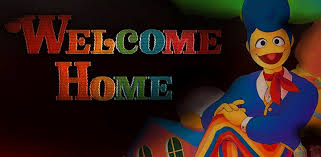
Despite first impressions, Welcome Home is a horror–tinged web-project built as an alternate reality game (ARG) as well as a “lost media” restoration site. This piece serves both as the “archive” or “restoration” project, at the same time that is an interface through which players explore hidden content: secret pages, hidden text, image & audio artifacts, guestbook entries, puzzles. It has dimensions to discover – it is not just an experience of reading content, but an experience of exploring, clicking, discovering, and peeling back hidden yet intentional layers. This expands our understanding of the act of reading, no? One of the things that is fascinating here is that it is not simply confined to the piece itself – the Welcome Home website. Instead, fans analyze, share, document hidden clues; the community includes people decoding codes, sharing theories. The mysteries (hidden text, puzzles) are designed for community involvement. This is important to how this artist designs, and more broadly, how meaning is co-created in the age of participatory media-making. Maya did a fantastic job at sharing how this website is a unique and complex narrative world. She showed us a glimpse of the many hidden messages that are disturbing or ambiguous. Welcome Home is not just a site, but also a portal where the story “lives on” and haunts us. Readers are situated as a “neighbor,” invited into this world, and invited to witness. Ultimately, the reader/player can’t always know what is fiction vs what is “in-universe.” There is a dark shadow to the blurring of these boundaries. And yet, this shadow ambiguity is part of the overall seduction and appeal. Somehow all this emphasizes the responsibility and work involved in being a close reader (of any world).
Façade
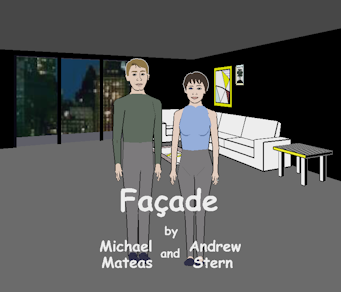
Façade unfolds through direct real-time interaction. The reader/player finds themselves inside an intimate drama where every typed word can alter emotional dynamics between Trip and Grace. This piece is rooted in the dream of “procedural authorship”—that is that natural language processes could enable a story to respond fluidly, as if alive. The narrative emerges moment-to-moment, co-authored by human and machine, emphasizing immediacy, presence, and dialogue. Sarah did a wonderful job at breaking down the actual game mechanic, presenting a flow chart of possible choices and ultimately knowing the six possible endings that are coded into the interface. Façade is often called the first true “interactive drama” — blending the aesthetics of theatre, film, and literature with game interactivity. Façade has become a landmark in AI-based storytelling research, because it’s procedural approach anticipated later developments in emergent narrative, machine learning for dialogue, and interactive performance systems. I love how Sarah knew this piece in-and-out, and her self-confessed love-hate relationship with it makes so much sense to me. Perhaps this love-hate feeling for it added to her ability to open it up for us so thoroughly. Despite the fact that all of you did not have access to the game play, last night during our collective “walkthrough” you might have felt that feeling of what good e-lit aspires to be – a living, responsive performance shared between human and computer. 👏☺️👍
How we can learn from these elit pieces (in connection)…
Both of these selections (bravo Maya & Sarah👏👏) share a deep interest in the relationship between reader/navigator/player and a storyworld.
Each asks what it means to enter a narrative space and be implicated in it (like a “guest”)—whether as a participant trying to mend a marriage (Façade) or as a “neighbor” uncovering a lost show (Welcome Home). They both blur boundaries between author, audience, and medium, inviting readers to perform narrative through interaction rather than consume it passively.
Façade’s procedural immediacy versus Welcome Home’s fragmented nostalgia—marks an evolution in digital storytelling. From the fantasy of seamless conversation with digital characters, to the fascination with the broken, haunted textures of media itself: Façade dreams of living stories; while Welcome Home dreams of stories that refuse to die.
Your to-do list
Please read the following selections by Jason & Jen:
- Presentation 3 by Jason: Yardley, PA
- Presentation 4 by Jen: Avenue S
Blog due: Blog about your reading experience and understanding of Yardley, PA & Avenue S
