As we head towards the holiday, I want to share my gratitude for our class, and how thoughtful you have all been this semester thus far.
I am glad your were able to proceed with the Elit Workshop designed to “jump-start” the process of formulating your own elit story development. Writing your own #elit piece will involve some basic steps over the remainder of our time together. As I mentioned in class, this process is ultimately iterative which means you might cycle back-and-forth in the steps needed to be taken. The steps will include:
Researching the concept(s) you come up with in order to have a clearer sense of how you might approach design and implementation.
Writing a script, a storyboard, and outline/map, and/or a timeline of activities.
Collecting and curating required multimedia elements — text, images, audio, video, oral history, interviews, selfies, and digital tools applications, etc.
Constructing the narrative using selected digital tools. Play around with digital tools that best suit your implementation efforts.
Sharing and reflect on the developing story for feedback.
Please remember that the creative process is rarely linear.
Your to-do list:
As per our in-class workshop on 11/24 – Please remember to submit your initial concept for your final elit project in this document (see your name included at the bottom of the document). I will be reading everybody’s ideas in time for our next meeting on 12/1.
Your blog for this week is a progress report on your on-going work. It should include the description of the project along with a sense of your overall working plan and a timeline. We will discuss digital tools and storyboarding in our next class.
Enjoy the time off and a treat!
Happy Thanksgiving to all of you!
I am hoping you will heap your plate full, and enjoy the nourishment. And I hope that each of your hearts will be full too…
Last night we concluded our Walkthrough Presentation Series. This marks the end of our “tour” of some examples of electronic literature. I am grateful for everyone’s thoughtful engagement with the selected works. I think we have received a solid “glimpse” of electronic literature’s diversity (formally, culturally, and conceptually). It is a radically open field that challenges conventional ideas about what literature is, how it is made, and who gets to participate in it. There is no doubt that digital media has expanded what counts as “writing,” and how audiences encounter it. Now we turn our attention to our own imagination(s). In the time we have remaining, you will be writing your own electronic literature. You are all invited to lean into your own creative inspiration as we move forward in the final month of class.
Our time remaining
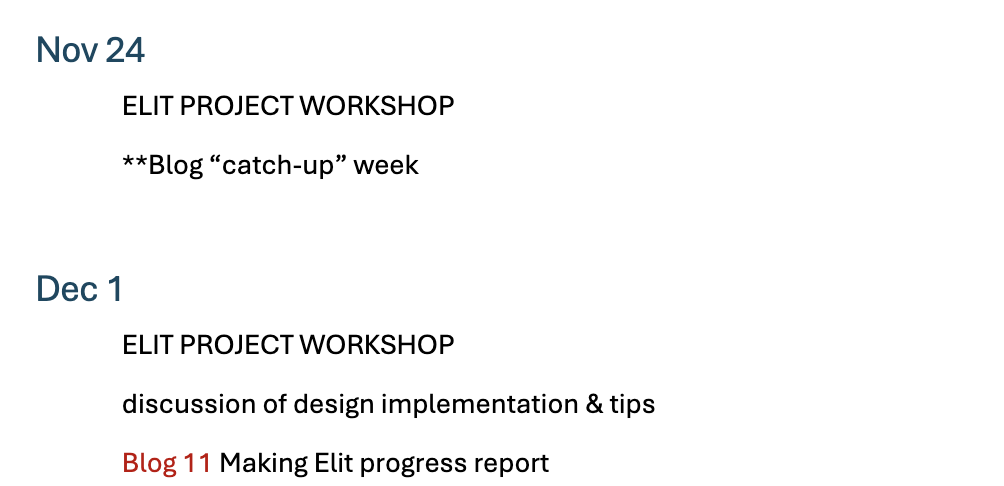
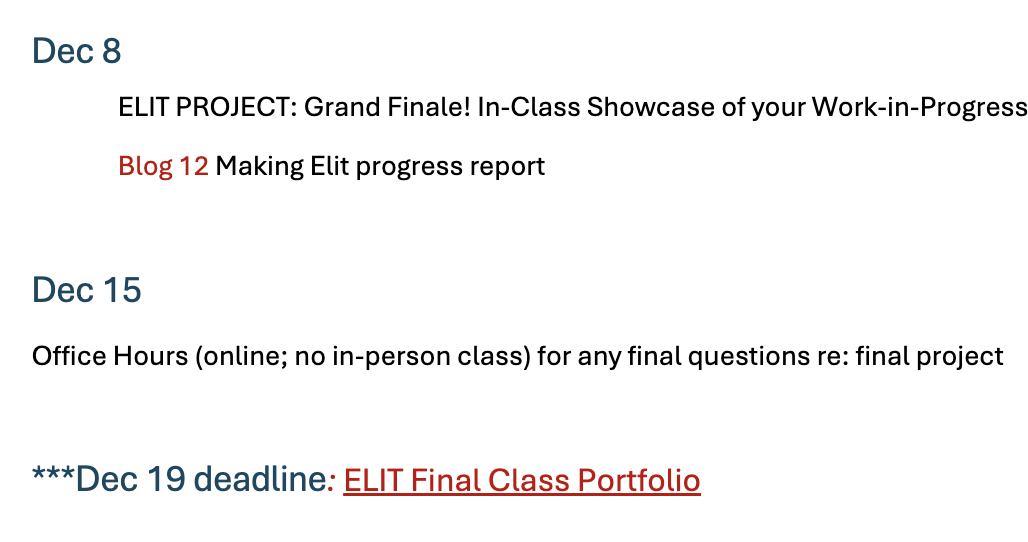
I shared our schedule “snapshot” regarding our final course meetings at the beginning of class. Please note the plans for the final phase of Elit Class:
Blackout Poetry Tool
Thank you Nas for a fun and thought provoking “spin” through the Blackout Poetry Tool by Jazer Chand. The resulting reflections regarding machine writing versus human writing were a good way to close out our consideration of elit. As a reference point, traditional blackout poetry is a creative form in which a poet takes an existing text and redacts, obscures, or “blacks out” words, leaving behind a select few to form a new poem. This established tradition already posits a “dialogue” between two writers. With Chand’s tool there is an additional expansion to this tradition of interactive co-writing. Here we encounter multiple “modes” of interaction between human and computer, making us think about the relationship between the reader (or user) and the writer (or automated/algorithmic system). Playing around with this interface definitely prompts us to think about different ways humans and machines (in tandem) transform the writing process. To generate unexpected creative connections through subtractive writing reveals surprising phrasing that the poet may not have invented consciously. This makes us think more deeply about what comprises creativity, intuition, logic, emotion, …and ultimately, intention in our writing. Rather than simply using a computer to automatically generate a poem, the tool gives us different “relational” models. It makes us confront how creativity might be shared between human intuition and algorithmic logic. The Blackout Poetry Tool invites us to think about control, randomness, and co-creation. While blackout poetry has always challenged fixed notions of authorship, this computational tool adds a new layer, making us consider what “poetry” means to us when a machine is involved.
200 Castles
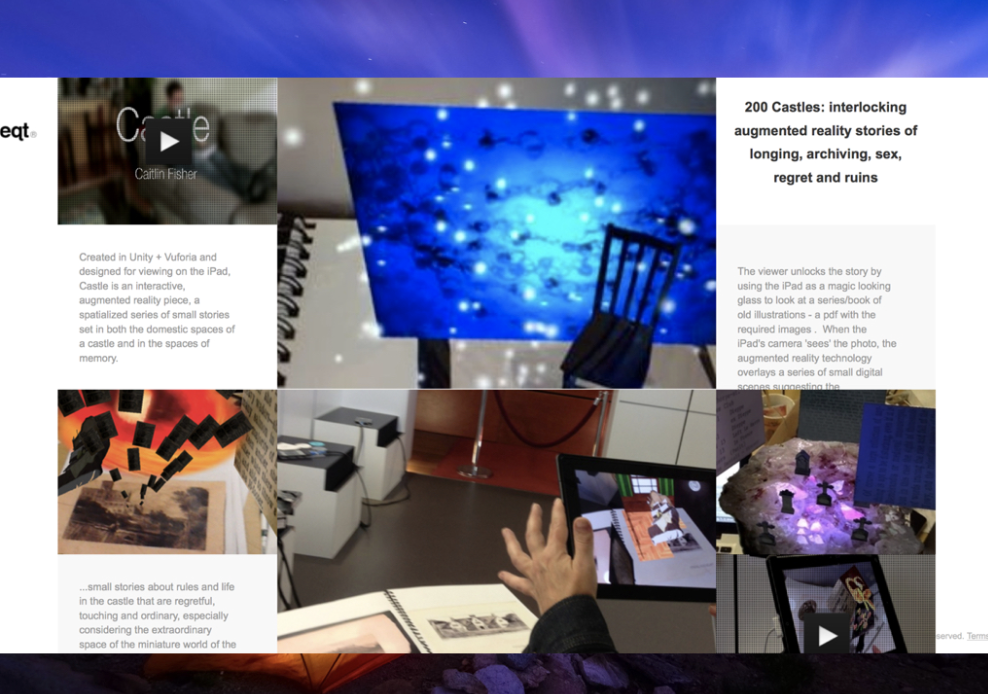
Lareice chose to present on 200 Castles by Caitlin Fisher. The work was originally developed in Unity for the iPad. I am not sure why Lareice chose this, since the work is no longer generally accessible and she herself did not access it directly.
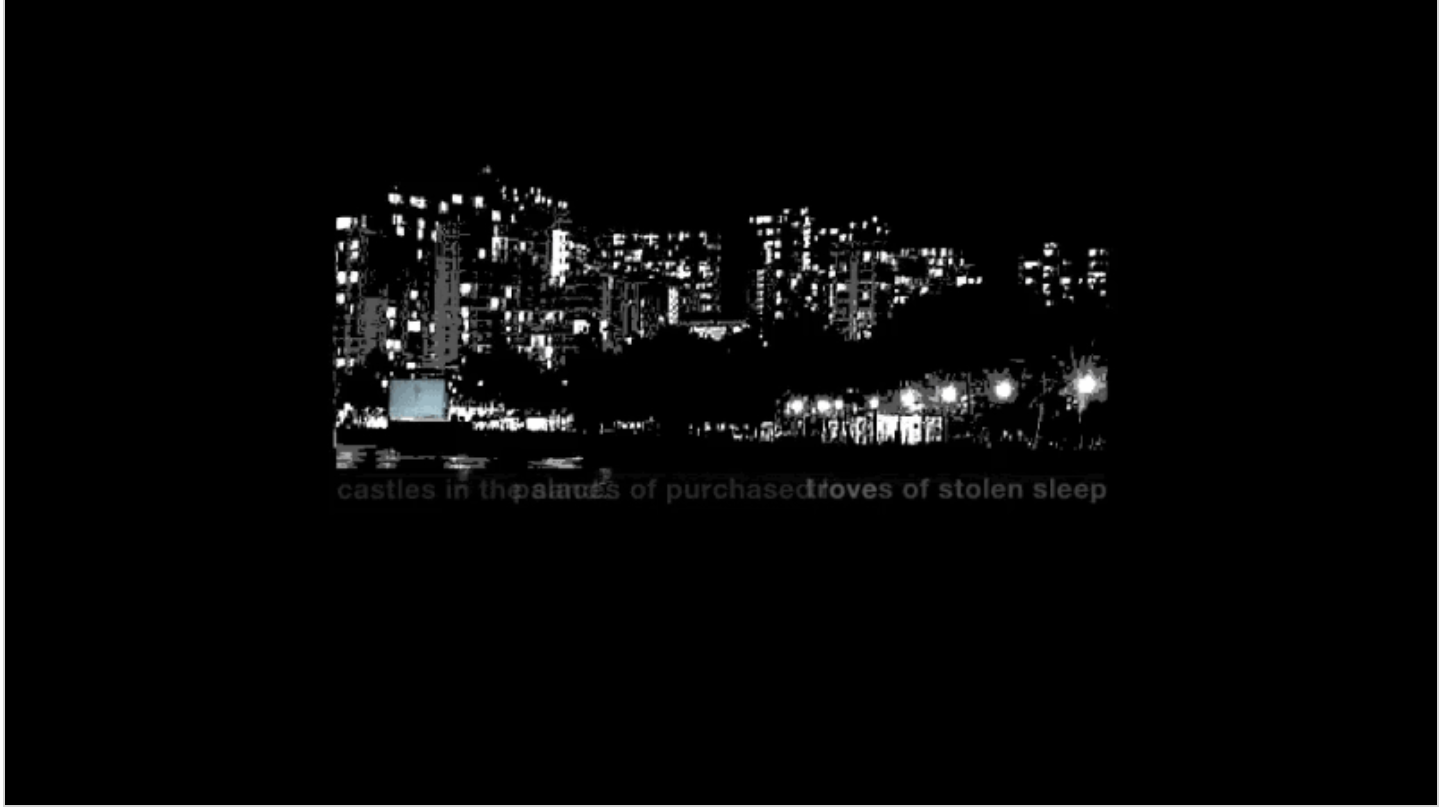
In this augmented reality story users can unlock small vignettes by pointing their device camera at images. 200 Castles demonstrates how augmented reality can support lyrical, memory-driven storytelling through touchstone interactions. These interactions with “lexia” (words) and image are a lot like “unlocking” secret dimensions that lay just beyond the surface. In the end, the non-linear design of this piece allows for a fragmented yet resonant reading experience. It is like roaming in unending rooms in an mysterious archival castle. It seems to me that the form this augmentation takes mirrors how we remember places and histories (like piecing together shards of a broken looking glass or finding scattered pieces of an abstract puzzle).
Unfortunately, Lareice’s presentation lacked the possibility of a “walkthrough” which was the basis for the assignment. We were able to speak briefly about the way the piece was made, but we were not able to read it. Like I said in class, this is a superficial form of engagement. It is equivalent to looking at a book (its front and back cover) yet we lack the deeper knowledge that can only come from reading it. It was a disappointing way to close our overall engagement with electronic literature. At least we were able to think for a moment about the potential affordances of augmented reality in creating new story worlds.
For next week
Please write a short blog about your early ideas for your final project of your own elit. What story/stories do you want to tell? How do you imagine them unfolding? In what ways will the reader experience them, and how will you introduce a realm for reader interactivity? This blog will be a preview of what you hope to work on in our final workshops for class.
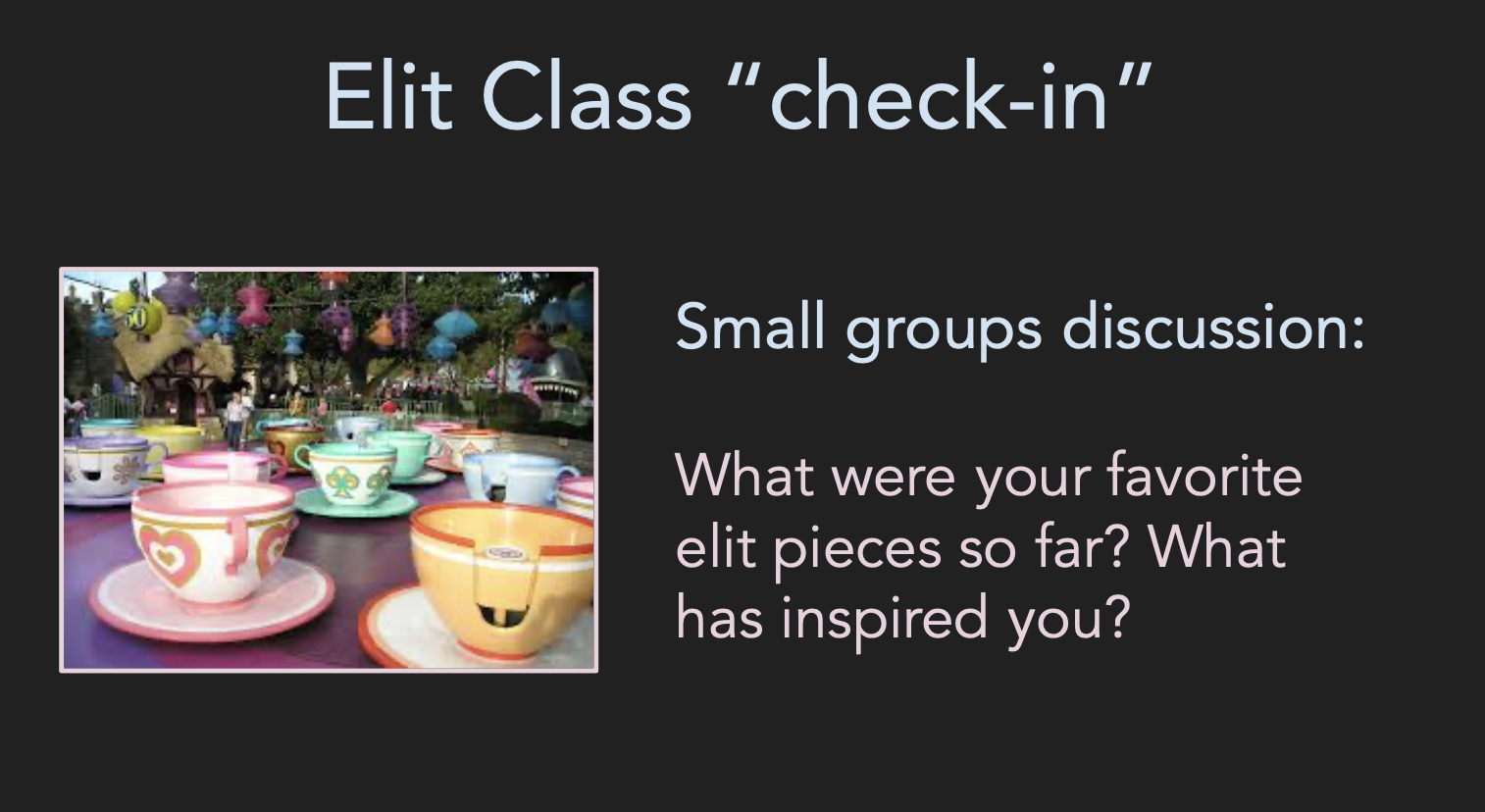
I am glad we started class with some opening reflections on what is possible regarding your final projects for Electronic Literature class. I hope your freewriting time and the open discussion with peers helped open up some early ideas about what you would like to make in the final stretch of Elit Class together.
Death of the Author?
In his 1967 essay “The Death of the Author,” Roland Barthes argues that the meaning of a text does not reside in authorial intention (what the author intended to say). Rather, the meaning of a text emerges from and through the reader’s engagement. In other words, the interpretation of literature belongs to the reader rather than the author. Meaning is not given by the author but it is produced by the reader. After our discussion on Monday, I started to think about the pairing of these two elit pieces with this Barthesian idea of the “readerly” versus the “writerly” text, and his well known claim that “the birth of the reader must be at the cost of the death of the author.”
Thanks to both Jenny and Hunter for their thoughtful presentations on both of these elit readings. On face value, the two works are seemingly disparate. But ultimately, they both have things to say about the dynamics of authorship and readership.
Retratos vivos de mamá
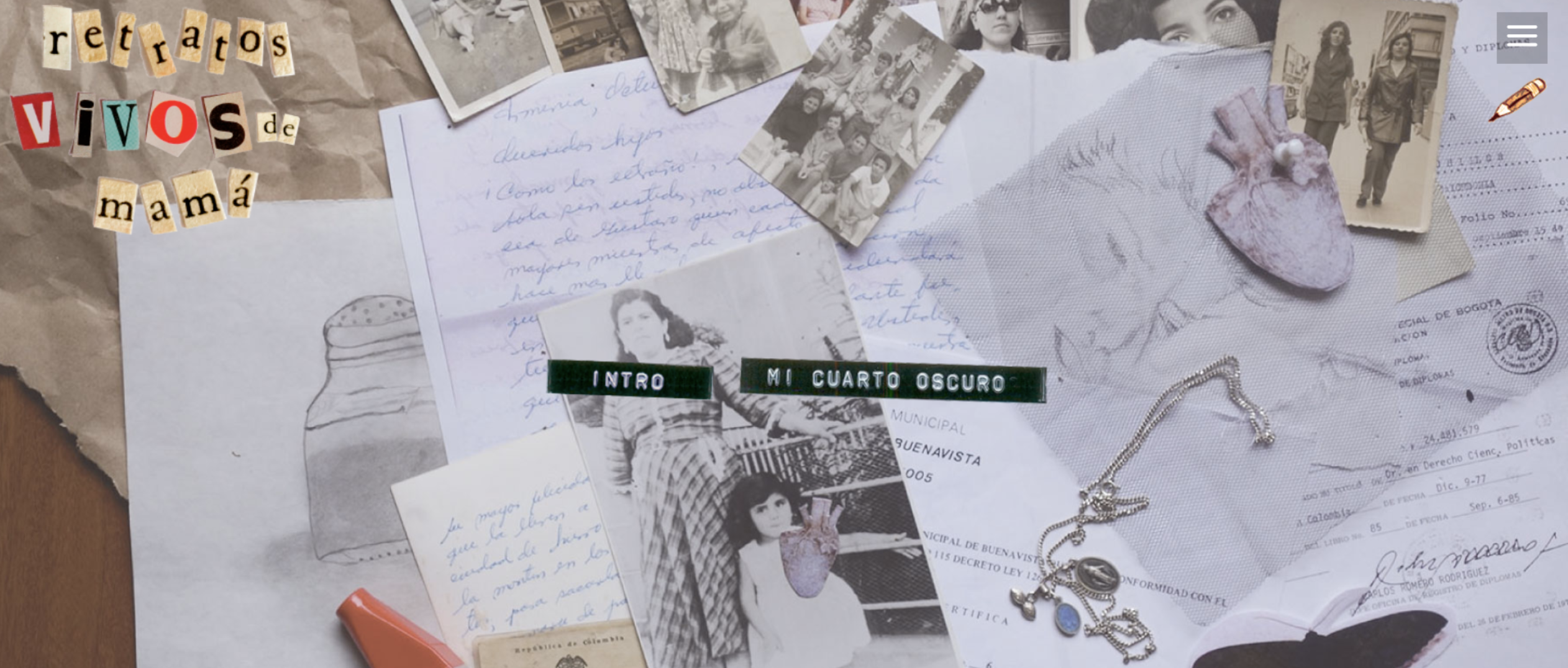
Retratos vivos de mamá by is a beautiful scrapbook and collage of personal bereavement, grief, and the intimate experience of mourning. It is a “living book” that continues to expand in time with new components to the work added as the author moves through the very personal and potent experience of grief. Photos, sketches, videos and recorded sound are layered with her own text. These sensory traces of a life stand in for Mama. Multi-modal forms of media become proxy for the body and voice that are no longer there. The layering produces a feeling of a living portrait made out of remaining objects and artifacts that her unique human life has left behind. As Jenny made evident in her walkthrough, grief is both a private experience, but here, it is simultaneously offered up publicly as a cultural object. With Retratos vivos de mamá, we are asked to believe that digital media can preserve the presence of the dead. As the multimodal artifacts let absence feel “present” in the reader’s experience, what is at stake in re-creating that presence? And on whose terms?
Writers Are Not Strangers
On the other hand, we read Writers Are Not Strangers. This is an interactive fiction in which the reader or player is asked to rate fiction fragments. In this way, the reader enters into a meta-critical “loop” about writing, judgement and audience. The protagonist Alix is a YouTuber and writer whose mother is dying. The reader rates Alix’s work and becomes a key engine in how Alix’s story plays out. The story itself blends text and interface elements like rating stars, scores, and “reader as judge” mechanics. This flips the usual power dynamic. In a traditional framework, a writer presents (and a reader consumes). But here, a reader judges (and a writer reacts). Writers Are Not Strangers connects the mechanics of judgment (you, the reader, assign scores) with the emotional consequences for the character. The fact that you-the-reader rate the fragments isn’t just a novelty. This is the message. The interface enacts a problem: writers are subject to metrics, readers enact judgment. And of course, this raises ethical questions. As readers, what responsibilities do we have?
Authorship and death in the digital age?
Both Retratos vivos de mamá and Writers Are Not Strangers examine how digital media mediate human connection, whether through memory of the dead or in relationship to the artist in a consumer-driven world. Both show how electronic literature turns interaction itself into an act of meaning-making. InRetratos vivos de mamáthe “author” of meaning is not the biographical mother or daughter but the reader, who reconstructs significance from fragments. In Writers Are Not Strangers the relationship between author, reader, and meaning is dominated by ratings, metrics, and feedback loops. In the end, both readings this week make us look closely at authorship in digital contexts: one through memory and mourning, the other through metrics and mediation. Roland Barthes declared that the author must die for the reader to be born. And this week in elit class, we catch a glimpse of the fantasy of death never being final. In Retratos vivos de mamá, the author returns as an affective ghost, and in Writers Are Not Strangers, Alix survives only through the algorithmic engagement of her readers.
Thanks so much to both Tyler and Cindy for effectively walking us all through All Your Time Tossed Selves and Hannah Feels this week. As I mentioned in my last blog, I keep seeing connections in these “double header” presentations, although this week seems to be a looser tie 🤔. Both “Hannah Feels” by Gavin Inglis and “All Your Time Tossed Selves” by Porpentine use interactive storytelling to explore the tension between our own agency, and our own constraints as human beings. I left class last Monday evening contemplating the way time plays tricks on all of us. And I was thinking about the seemingly small choices we all have to make. How in the end, somehow, so many smaller choices add up to a larger story of who are in this world.
All Our Time Tossed Selves
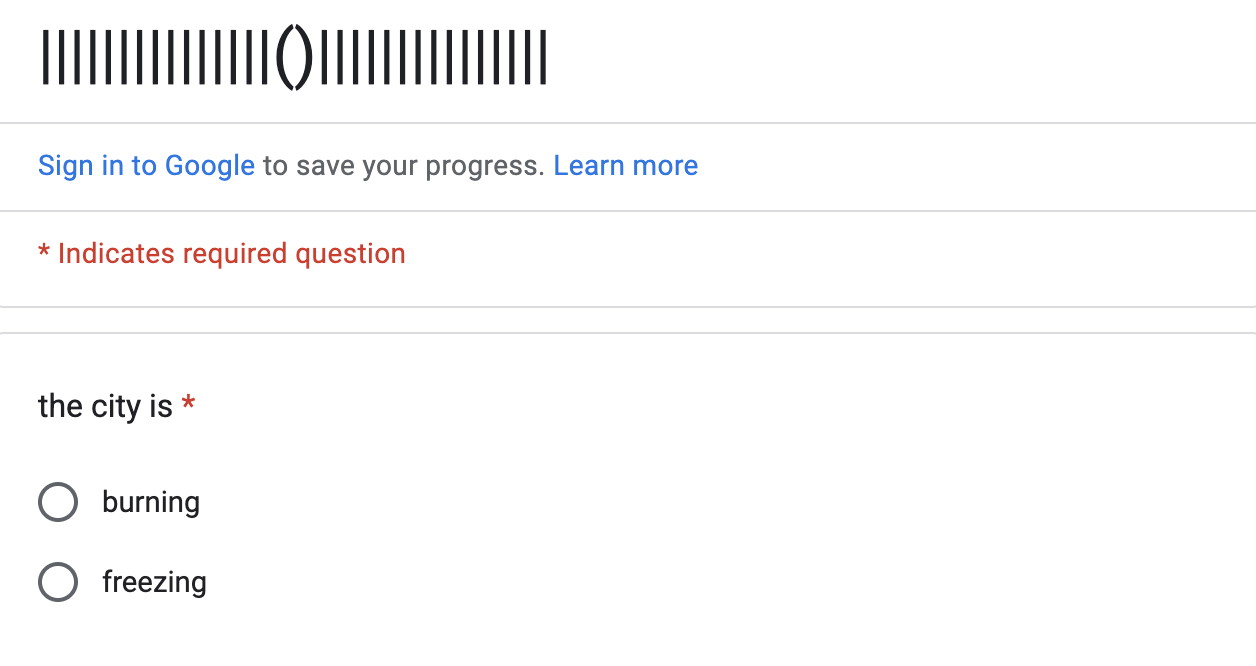
Tyler did a great job at illuminating how such a simple digital survey instrument (like the ubiquitous “google form”) can mirror the choices and micro navigations in everyday life. The piece unfolds as an interactive text in which readers click through choices that evoke the poetic disorientation amidst a fallen or doomed civilization. Rather than a traditional plot, the story is experienced as a series of associative leaps, where choices often feel less like control and more like surrender to the logic of the work’s emotional circuitry. Tyler scanned the room for your informal play-through strategies. Some of you went with what felt “right”, some chose randomly without any real conviction, some tried to build upon a loose logic of their own making. Is that how we ultimately live our lives? What Tyler made apparent was that many of these “moments of choice” were simply an illusion without much consequence. The city is always going to implode. The “choices” in the google form act as portals through shifting versions of the self, breaking with any cohesive or linear experience. In the end, we come to realize that the player’s “reading/writing” navigation mirrors the internal work of piecing together a scattered psyche. What is at stake here? Our sense of our own “cohesive self”? Free will or fate? Each click we make is both a decision and an act of reconstruction. We as readers are invited to make choices by clicking through links that seem to offer control over the direction of the story. But in the end these choices often loop back, collapse, or lead to outcomes that feel inevitable. All Our Time Tossed Selves pulls the curtain back on the illusion of agency in human life. This piece lets us know that fate is not a single, linear destiny but a looping network of multiple forms of self. Life is stringing along the many choices we make or fail to make, …each tossed through time and memory. It is a haunting piece, and Porpentine’s beautiful and wistful title, All Our Time Tossed Selves, is the key to understanding it.
Hannah Feels
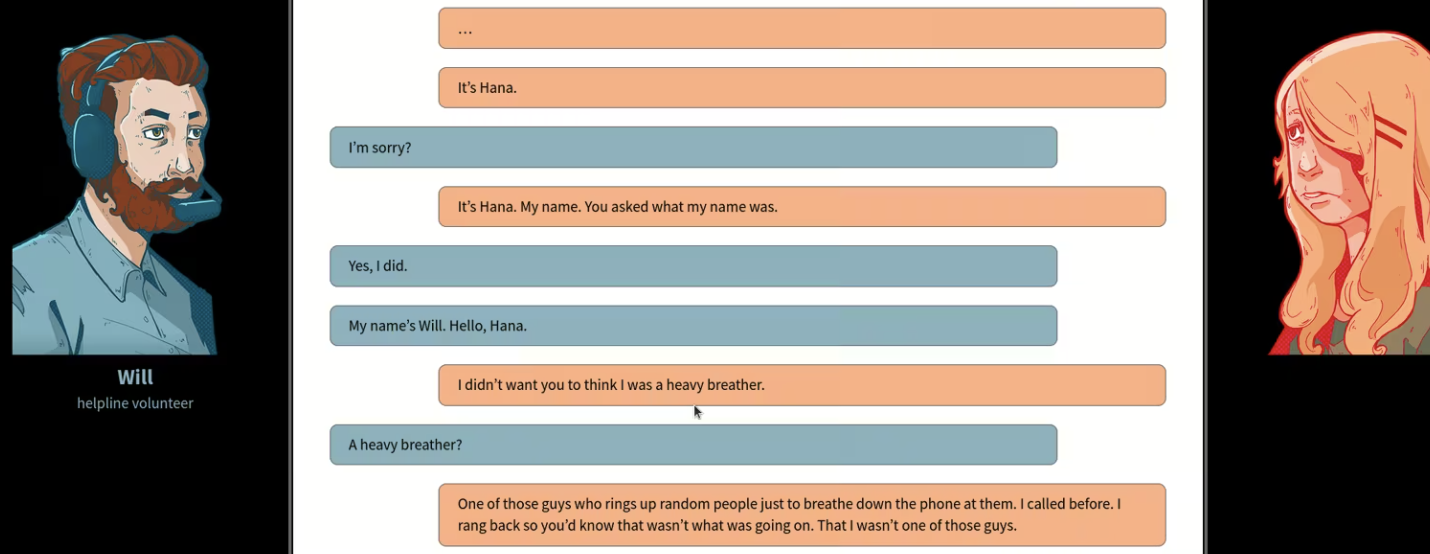
After a short break we turned to a another powerful piece of interactive fiction that uses player choice to probe the limits of empathy, agency, and control. Hannah Feels is about a young woman navigating anxiety, social discomfort, and self-doubt. By making decisions on her behalf, we as readers become complicit in shaping her emotional trajectory. To echo our discussion, we become responsible for her. We can attempt to “help” or “fix” her by navigating the interactions she has, but it soon becomes clear that these subtle interactions might backfire, emphasizing how difficult it is to impose external control on another person’s emotional reality. Thanks to Cindy for taking us through a potent and painful interface for storytelling. It was not easy to read this out loud in the room, but you did that work with all of us present and bearing witness to the acute pain of self-harm. We were confronted with the inner turmoil of self-violation by cutting. The more the reader-as-player tries to assert control, the more the story insists on the complexity and autonomy of Hannah’s inner life. In the end, our feeling of “responsibility” becomes a meditation on empathy. Hannah Feels seems to suggest that free will exists, but always within the constraints of context. That context may be mental, emotional, or even structural. We come to understand that freedom (for us as “readers” or for Hannah) is never absolute. It seems to me that both of our readings this week have reminded us that in digital narratives — as in life — choice is never as free as it seems.
I really enjoyed our discussion this week. The “walkthrough” presentations by both Ava and Emily had us thinking together in new ways, and I think the pairing of Ava’s presentation onAsk Me about the Moon, and Emily’s presentation on The Vine & the Fish also yielded a dynamic and thoughtful discussion. As we continue to proceed through our class together, I have noticed the way in which each week’s selections either match-up or mash-up in ways that draw out deeper understanding of electronic literature. In other words, the randomness of “the presentation roster” has somehow yielded new meaning for me, as we take in each new text in unforseen pairings.
Ask Me about the Moon
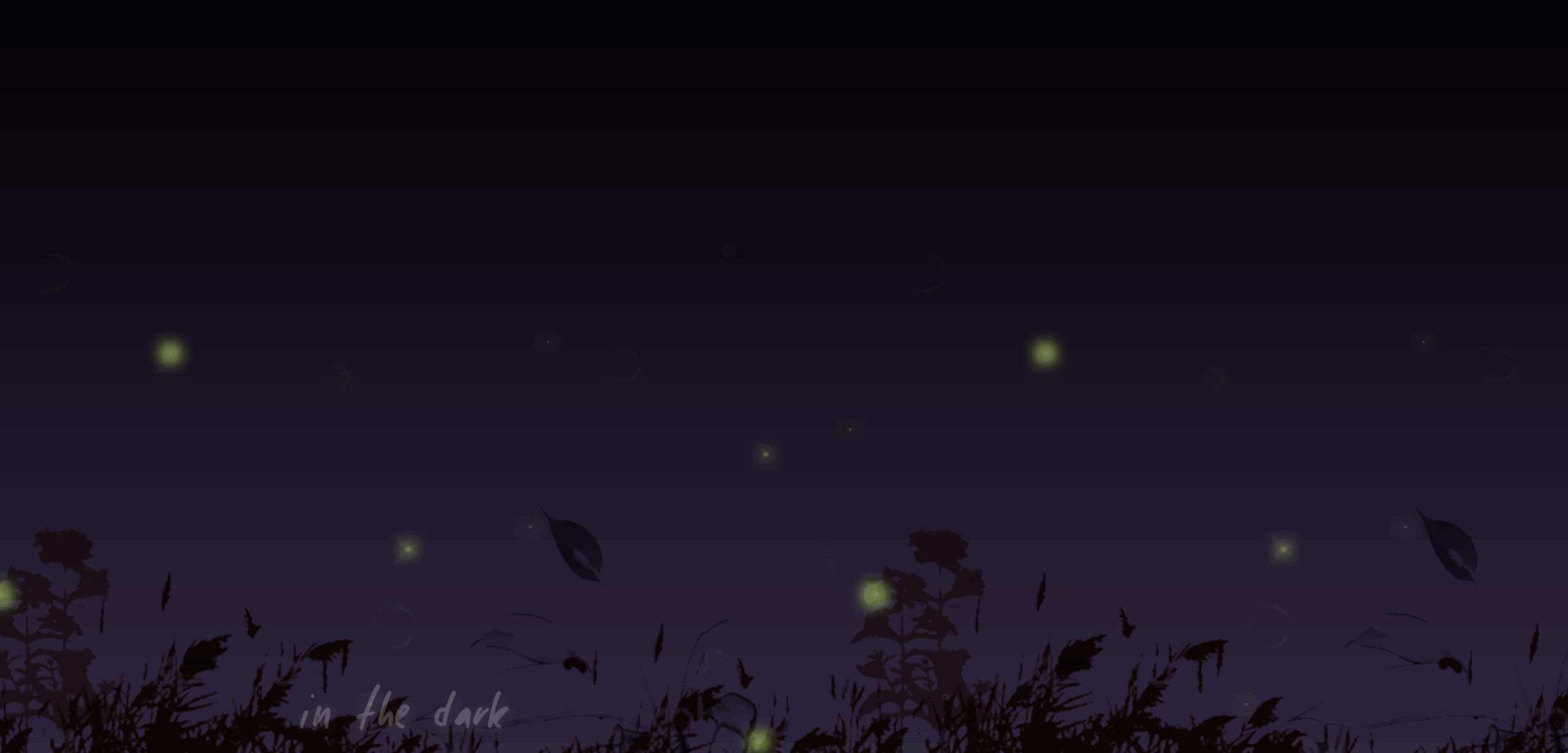
Thank you for a wonderful presentation Ava on a piece that has always been a personal favorite. Perhaps it is the special blend of beautiful lyric, stark image, ethics, scholarship, and cultural critique, all blended with certain subtlety, that have always spoken to me regarding this elit piece by John David Zuern. Ask me about the Moon evokes the hidden labour and infrastructural underside of tourism in Hawai‘i, and like the timeless tides of the ocean, it brings us in and out of the problematic layering of tourism, labour, and invisibility. Here, Hawaii is not just a scenic fantasy backdrop, but conceptual frame. Tropical leisure is juxtaposed against service industry labour, and we as readers are invited to reflect on the hidden damage of tourism economies, infrastructural degradation, and the poetics of place. I appreciated how Ava had us pause to consider the rhythm and effect of Zuern’s lyric form. Her analysis of how incorporated sounds, the actual rhyme scheme, and the lyric tone itself, mirrors the ebb and flow of repetition (and even exhaustion). We are forced to reconsider our “tourist gaze” and think about what we choose to see as opposed to the reality of an imbalance (rooted in unseen work and ecological pressures). It is a powerful and complex piece of art, and Ava helped us all see that effectively.
The Vine and the Fish
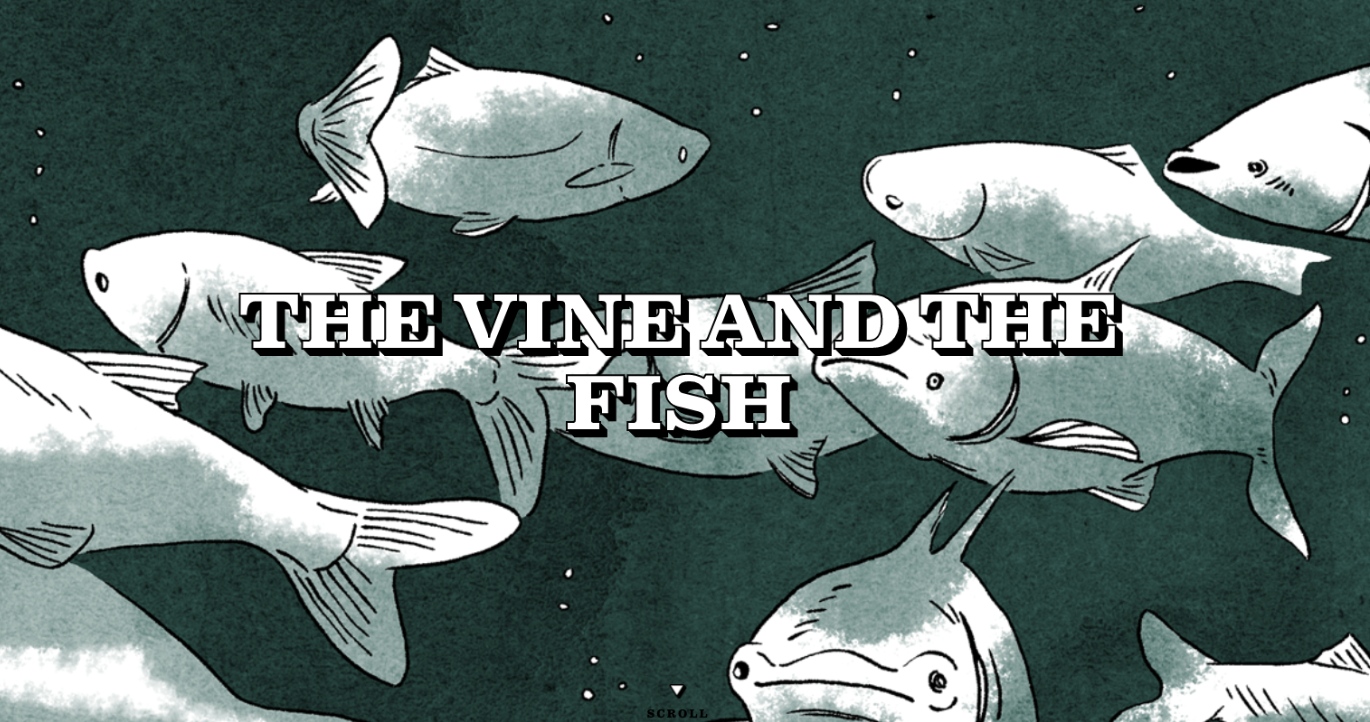
Emily’s presentation was a perfect “Part 2” of our class with her walkthrough of The Vine and the Fish. This work also draws on ecological metaphors (invasive vines, imported fish) while connecting these ideas to the protagonist’s embodied experiences of othering. Sentences are often spare, at times fragmentary. The color palette is a subtle and soothing celadon green. The piece itself could even be called gentle. This simple yet profound web comic is a reflection on migration, belonging, and how language and classification can render people (especially Asian diasporic subjects) as visible or invisible. The vine’s creeping growth and the carp’s invasive reputation function as “double-speak”. On the one hand they are ecological descriptions (kudzu, silverfin, etc.), and on the other hand they are racially inflected metaphors about immigration. The Vine and the Fish foregrounds acts of seeing and being seen. And it makes us all see that the language of classification also does ethical work. Emily’s presentation was especially effective when she juxtaposed her “live” walkthrough of the interactive piece with a rendering of the “pdf” version (the static panels of the web comic). This helped us understand the affordances that come with interactive elements in elit (even if quite simple ones like in this piece). We agreed that the elit version of this story feels more like a journey through time and space, embedding both personal and political reflections as they leap off of the screen.
Visibility & Invisibility
Both of the elit reading this week engage with what is made visible and what is kept invisible. Through web animation, scrolling, layered text or imagery they make apparent the problems of hidden labour, hidden identity, and ultimately, hidden power. These two narratives have both used digital interactivity to emphasize what is visible while concealing and/or revealing something deeper. That mix of surface appearance vs. underlying reality is what impacted me as we looked at these two pieces together.
October has ripened with its crisp air, its shimmering light, and its colored leaves like shards of golden glass refracting the hues of harvest and reflection. Autumn is a time to pause, to pay attention, and to take account, as our daytime dims and becomes shorter. I hope you have found your own moments to enjoy these rhythmic shifts in the natural world, because they are a bounty that we all should celebrate and share. Nothing lasts forever, but it is beautiful to behold that one thing passes into another. Nature reminds us of this regularly, especially with the shift in seasons.
It was wonderful to spend time thinking about two new pieces thanks to the smart walkthroughs presented by both Jason & Jen last evening. I am so glad to have read Yardley, PA and also Avenue S with all of you on the same night. Thank you to Jason & Jen for taking us through the unique contributions of these two “story worlds”. Perhaps the common thread in these two pieces is the idea of ephemerality, and also erasure.
Yardley, PA
When thinking about Yardley, PA together, we talked about nature, and what is fleeting and human. Thanks Jason for guiding us to think about this piece in the context of collective auditory/visual performance. I think this special elit piece brings us new “kinetic awareness” by asking us to think about how pressing the keys feels— mechanical, musical, embodied? It fosters a kind of mindfulness that Jason spoke about. The title “Yardley, PA” is a small, historic town along the Delaware River just north of Philadelphia and not too far from our own surroundings. It’s a quiet, tree-lined, nostalgic sense of hometown USA. By naming the piece after a real, mundane place, Anderson immediately grounds his abstract digital experiment in geography and memory. He creates a new way to capture a “sense of place”. Anderson & Libertino have constructed a terrain of language, sound, and performance and a place reimagined through digital mediation. Yardley, PA is an experience of place, a digital “place” that you navigate through touch and rhythm (rather than through streets or coordinates). The reader doesn’t read about Yardley so much as move through it sonically and gesturally, with poetic verses leading your way like the traces of one’s own broken memories. This new orientation harnesses a new kind of ephemeral “story magic” that I believe can be emblematic of some electronic literature.
Avenue S
In a different sense, Avenue S also becomes a meditation on “sense of place”. This web-based expansion of Jody Zellen’s long-running Ghost City project is a “poetic meditation” on isolation during the pandemic using topics such as walking, nature, empty public spaces, politics, and protest. I am glad that Jen chose this piece because it pulled on her own graphic-artist “heart strings”. The work functions both as personal journal (an artist’s response to the lockdown experience) and as public net art. Avenue S is a sprawling network of small pages and tiles, experienced by clicking and wandering. The “text” (mostly visual rather than lexical) is distributed across images, animated GIFs, labels, and micro-texts that accumulate as the reader moves through the site. This produces a collage or patchwork reading experience rather than a fixed narrative. The hypertextual navigation style (there is no singular or set way to “read” this piece) is one procedural hallmark of electronic literature. The overall effect is that the work archives and aestheticizes the distinct emptiness of COVID-19 memories, while inviting users to emotionally inhabit this specific place in time. And I think many of us felt this revisitation when “reading” it. For me, this piece reminds me of what I mostly choose to forget. And I think that Jen’s “gift” to us all (the “pandemic mask”) was a thoughtful gesture. Indeed this specific object brings us right back to the recent shared memory of the pandemic. It is a tangible trace of something we have tried to leave behind. As I touched the mask last night, I was remembering the struggle through such a challenging and painful time. Avenue S is like that. It brings us right back through its mediated interactive story-scape.
Closing thoughts on ephemerality
While Yardley, PA performs ephemerality as live, sonic immediacy, Avenue S curates it as an “archival drift”. Yardley, PA produces transient moments of text and tone that vanish as quickly as they appear, dissolving in the moment of interaction. The reader’s path in Avenue S is temporary and idiosyncratic, evoking the impermanent rhythms of city life during the pandemic. This piece dissolves in the endless sprawl of networked time. Both works ultimately treat the digital as a medium where language, sound, and image flicker into being only to fade, making the experience of disappearance itself electronic literature’s subject.
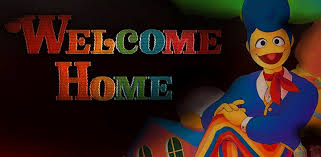
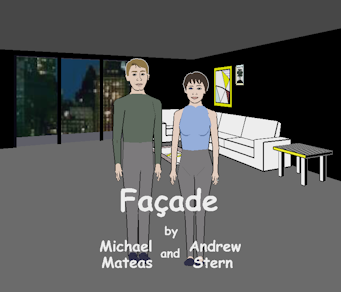
Despite the fact that we were grounded in Zoom class due to the windstorm last night, we still were able to have a truly fascinating and meaningful conversation thanks to Maya & Sarah and their selection of two great “headliner” pieces of elit. Maya’s selection (Welcome Home) is not found in the most recent ELC volume, but it truly fits into a broad understanding of what is considered electronic literature these days. Sarah’s selection of Façade is a known “cult classic” and has been upheld as a foundation to the field for sometime. Covering these two pieces last night was the perfect way to open our “tour” together. Both Welcome Home and Façade and can indeed be considered meaningful works of electronic literature. Each piece uses digital media to rethink how stories can be told, but they do so through opposite strategies of engagement.
Welcome Home
Despite first impressions, Welcome Home is a horror–tinged web-project built as an alternate reality game (ARG) as well as a “lost media” restoration site. This piece serves both as the “archive” or “restoration” project, at the same time that is an interface through which players explore hidden content: secret pages, hidden text, image & audio artifacts, guestbook entries, puzzles. It has dimensions to discover – it is not just an experience of reading content, but an experience of exploring, clicking, discovering, and peeling back hidden yet intentional layers. This expands our understanding of the act of reading, no? One of the things that is fascinating here is that it is not simply confined to the piece itself – the Welcome Home website. Instead, fans analyze, share, document hidden clues; the community includes people decoding codes, sharing theories. The mysteries (hidden text, puzzles) are designed for community involvement. This is important to how this artist designs, and more broadly, how meaning is co-created in the age of participatory media-making. Maya did a fantastic job at sharing how this website is a unique and complex narrative world. She showed us a glimpse of the many hidden messages that are disturbing or ambiguous. Welcome Home is not just a site, but also a portal where the story “lives on” and haunts us. Readers are situated as a “neighbor,” invited into this world, and invited to witness. Ultimately, the reader/player can’t always know what is fiction vs what is “in-universe.” There is a dark shadow to the blurring of these boundaries. And yet, this shadow ambiguity is part of the overall seduction and appeal. Somehow all this emphasizes the responsibility and work involved in being a close reader (of any world).
Façade
Façade unfolds through direct real-time interaction. The reader/player finds themselves inside an intimate drama where every typed word can alter emotional dynamics between Trip and Grace. This piece is rooted in the dream of “procedural authorship”—that is that natural language processes could enable a story to respond fluidly, as if alive. The narrative emerges moment-to-moment, co-authored by human and machine, emphasizing immediacy, presence, and dialogue. Sarah did a wonderful job at breaking down the actual game mechanic, presenting a flow chart of possible choices and ultimately knowing the six possible endings that are coded into the interface. Façade is often called the first true “interactive drama” — blending the aesthetics of theatre, film, and literature with game interactivity. Façade has become a landmark in AI-based storytelling research, because it’s procedural approach anticipated later developments in emergent narrative, machine learning for dialogue, and interactive performance systems. I love how Sarah knew this piece in-and-out, and her self-confessed love-hate relationship with it makes so much sense to me. Perhaps this love-hate feeling for it added to her ability to open it up for us so thoroughly. Despite the fact that all of you did not have access to the game play, last night during our collective “walkthrough” you might have felt that feeling of what good e-lit aspires to be – a living, responsive performance shared between human and computer. 👏☺️👍
How we can learn from these elit pieces (in connection)…
Both of these selections (bravo Maya & Sarah👏👏) share a deep interest in the relationship between reader/navigator/player and a storyworld.
Each asks what it means to enter a narrative space and be implicated in it (like a “guest”)—whether as a participant trying to mend a marriage (Façade) or as a “neighbor” uncovering a lost show (Welcome Home). They both blur boundaries between author, audience, and medium, inviting readers to perform narrative through interaction rather than consume it passively.
Façade’s procedural immediacy versus Welcome Home’s fragmented nostalgia—marks an evolution in digital storytelling. From the fantasy of seamless conversation with digital characters, to the fascination with the broken, haunted textures of media itself: Façade dreams of living stories; while Welcome Home dreams of stories that refuse to die.
Your to-do list
Please read the following selections by Jason & Jen:
What a wonderful read through all of your blogs this past week. I must say that I had a clear feeling that many of you “turned a corner” in terms of your “warming up” to electronic literature. While the field continues to push categories/boundaries, it has become for many of you a more immersive and emotional experience. And despite the formal innovation in terms of storytelling, you also expressed a newfound relatability and accessibility in your experience of elit work.
Our agenda slides:
High Muck A Muck
We spent our class with the beautiful hypertext poem entitled High Muck a Muck, – a stunning collaborative work. High Muck-a-Muck: Playing Chinese is an interactive poem, consisting of a website and eight videos which explore the narratives and tensions of historical and contemporary Chinese immigration to Canada. High Muck a Muck is most intriguing especially because it was formed through an interdisciplinary collaboration of nine Canadian artists and programmers including Fred Wah, poet, Jin Zhang, composer; Nicola Harwood, project director and designer; Thomas Loh and Bessie Wapp, video artists and performers:, Hiromoto Ida, dancer; Patrice Leung, filmmaker; Tomoyo Ihaya, visual artist and Phillip Djwa, creative technologist. The convergence of so many gifted practitioners has produced an exceptionally rich and complex piece, which definitely pushes beyond the traditional confines of “text”.
We walked through many of the most significant images/tropes of the piece while sharing a sense of the diverse options for navigation. Here are your collective notes on this piece. Well done! The piece explores the multi-lenses of diaspora and globalism while provoking us to think further about the impact of dreams steeped in the challenges of exile or migration. We could all see the way in which embodiment (the body) is wrapped up in conflicted pasts and presents, and how the myths of immigration are often a gamble with many different resulting outcomes. The final tone of the work is ambiguous and dispersed, with a haunting lack of resolve. In other words, there will always be loss despite gains in this journey to a new world.
Your to-do list
Oct 6
Next week we will have a “break” in our rhythm in order to visit with the reference librarian Craig Anderson. He will be conducting an ONLINE WORKSHOP entitled “Library Research Toolkit Series: Digital Library Resources” at 4;30pm for us. Right now the link to register is: https://kean.libcal.com/event/14974663?hs=a
That said, the actual Zoom access link might be different. I am still awaiting an update from Craig on this information. Please stay tuned for confirmation of the link to join the online workshop on Monday 10/6. I will email you with any updates.
Your fourth blog post is due Oct 13. Blog about your reading experience and understanding of Facade & Welcome Home. We are lucky to have both Sarah and Maya kicking-off our Presentation Series with these two pieces.
Some blog prompts: What are some of the significant textual elements? How did you choose to navigate these texts? What visual, sound, interactive elements left an impression? What overall effect do these texts create? What themes and symbolic language emerge in navigating the text? What is literary about the text?
Our last class was the beginning of a semester-long conversation about literature, reading, writing, new forms of literacy. As I think back to what we covered together, there really is so much to consider when thinking about the act of reading in our lives. This quote from Jessica Pressman’s early article entitled “Navigating Electronic Literature” makes us all think further about how the act of reading might be changing: “Electronic Literature demonstrates how navigation is not only a central characteristic of the digital literary work and it’s aesthetic but also a primary source of its signification.” Where is the source of meaning produced when we read? How is the role of the reader changing? Can a reader also be a part-author of text? How so? I decided to have you all read Michael Joyce’s Twelve Blue in tandem with Pressman’s article as a way to build an early foundation for our journey into the world of electronic literature, and as a way to signal new experiences in reading and writing. We developed some collaborative notes on Twelve Blue and Pressman’s article. They full of insight and help set the tone for what is to come throughout this course.
New ways to read…
I want to share that I am impressed with you all. You are willing to share your earnest impression of new ideas and new experiences …..and you have even expressed anxiety, and discomfort. Your openness is a good sign. Learning is often linked to forms of vulnerability. And so your admittance of these unforeseen experiences in reading (at the start of our journey) is a sign that we are in for a great deal of authentic learning together in Elit class!
Our class slides:
“12 BLUE ISN’T ANYTHING, THINK OF LILACS WHEN THEY ARE GONE.”
everything can be read, every surface, every silence, every breath, every vacancy, every eddy, every current, every body, every absence, every darkness, every light……
Some ideas to consider from our discussion last Wednesday:
Michael Joyce’s Twelve Blue = a reading experience; a conceptual exploration.
Many expressed frustration, and many felt a sense of exploration and discovery emerge after some more time spent with the text. Perhaps we could claim that the piece was “writerly” but the story was never compelling because there was no cohesion. You observed a lack of any discernible pathway to reading. You also admitted that a lack of any identifiable closure was unsettling.
Themes/Motifs: reading & flowing; water- upstream/downstream, stillness & turbulence, being submerged, fluid and changing; memory; color; nature/seasons; traces; generations (young vs. more mature); major vs. minor; history; perception (looking); multiple paths/multiple meanings; “skyways” (routes, infrastructure, mobility); self-referencial elements
Character, plot and relationships: there are relationship “networks” but there was definitely some confusion – some readers knew some characters, other readers knew others, some of our knowledge of the text overlapped, some did not, etc.
Reading strategies: Some click on threads or the hyperlinks within the text randomly, some readers decide to stick consistently by a certain thread color, while others might discover the titles for each of the lexia tabs and use this as an attempt to “frame” possible meanings. Some readers think about the number 12 as a clue to a reading strategy, some decide to follow a numerical number pattern, while some attempt basic “note taking” and/or “mapping” in an attempt to discern patterns or meanings.
Assessment: 12 Blue reminds us all of the active role of the reader in creation – we are “navigators” beyond just readers; There is an underlying structure that cannot necessarily be apprehended but is determined by the code of the work. (This is the central illusion – that readers have agency through navigation, but still, the world is a closed design determined by the underlying code).
I think the idea of an illusion will be a keyword for us to consider throughout our exploration of Elit. With Twelve Blue, we struggled to apprehend an ending, but perhaps there is beauty in the fragments.
Some critical/review articles
This is list of links below is sinoly a follow up if you are still curious about this piece. These articles give you an idea of how critics/scholars write about a text like 12 Blue (this is optional reading, but thought it might be interesting for you):
-All of you have selected a date for your presentation. One more student in the class needs to add their elit piece/selection into our Course Calendar.
–Read High Muck A Muck (we will do a walkthrough together in the beginning of class)
-Your third blog post is due by next Monday. Blog about your reading experience and understanding of High Muck A Muck.
Again, it was great to see you all yesterday, and I feel like slowly but surely we are getting to know each other a bit more and we are starting to connect. I am glad that we devoted some time to the speed socializing exercise. It takes time to build trust in a community. This feeling of truer connection will pay off down the line in class, when we feel we can all learn from eachother as unique and different human beings. Also, it was a pleasure to read all of your introductory blogs!
Here are the slides from last week:
You are welcome to review our slides that cover an introduction to the most prominent genres of electronic literature (and they include some links to examples of each genre highlighted). This understanding of the general #elit “categories” will serve as a foundational vocabulary for our overall exploration of electronic literature throughout the semester.
The Electronic Literature Collections
I am so excited that you all have started to “surf” the Electronic Literature Collections)! Just peeking around and opening up different texts to discover is the beginning of something. Most of you have already chosen soemthing for your review presentation. I think the choices you have amade thus far are truly exciting and diverse. Please note, we will ofcially “settle” our Presentation/Review schedule next time. If you want to make a change there is still time to consider that. We will go over the Calendar one more time next Monday, and also, Lareice and Jenny will add their selections at that time. As you continue to peek at the Electronic Literature volumes this week, please notice the expectations & strategies you bring to the texts. What do you like & why? What frustrates you and why? Remember to be open to new experiences. In many ways, reading elit is a whole new world.
Your “to-do” list for next class:
–Read Pressman’s “Navigating Electronic Literature”. This essay is located in “About Electronic Literature: New Horizons for the Literary”.
-Your second blog post is due. Please write a reflection about your Twelve Blue reading experience in relation to Pressman’s article about reading elit.
Next Monday we will settle the Course Calendar together, discuss the readings above (that you are also blogging about). In addition, I will demonstrate an elit “walkthrough” to give you a feel of what is possible. And we will continue with this work for the week thereafter as well.
Looking forward to it!
Dr. Z
The official class site for Dr. Mia Zamora's Fall 2025 Electronic Literature course.