

Thanks so much to both Tyler and Cindy for effectively walking us all through All Your Time Tossed Selves and Hannah Feels this week. As I mentioned in my last blog, I keep seeing connections in these “double header” presentations, although this week seems to be a looser tie 🤔. Both “Hannah Feels” by Gavin Inglis and “All Your Time Tossed Selves” by Porpentine use interactive storytelling to explore the tension between our own agency, and our own constraints as human beings. I left class last Monday evening contemplating the way time plays tricks on all of us. And I was thinking about the seemingly small choices we all have to make. How in the end, somehow, so many smaller choices add up to a larger story of who are in this world.
All Our Time Tossed Selves
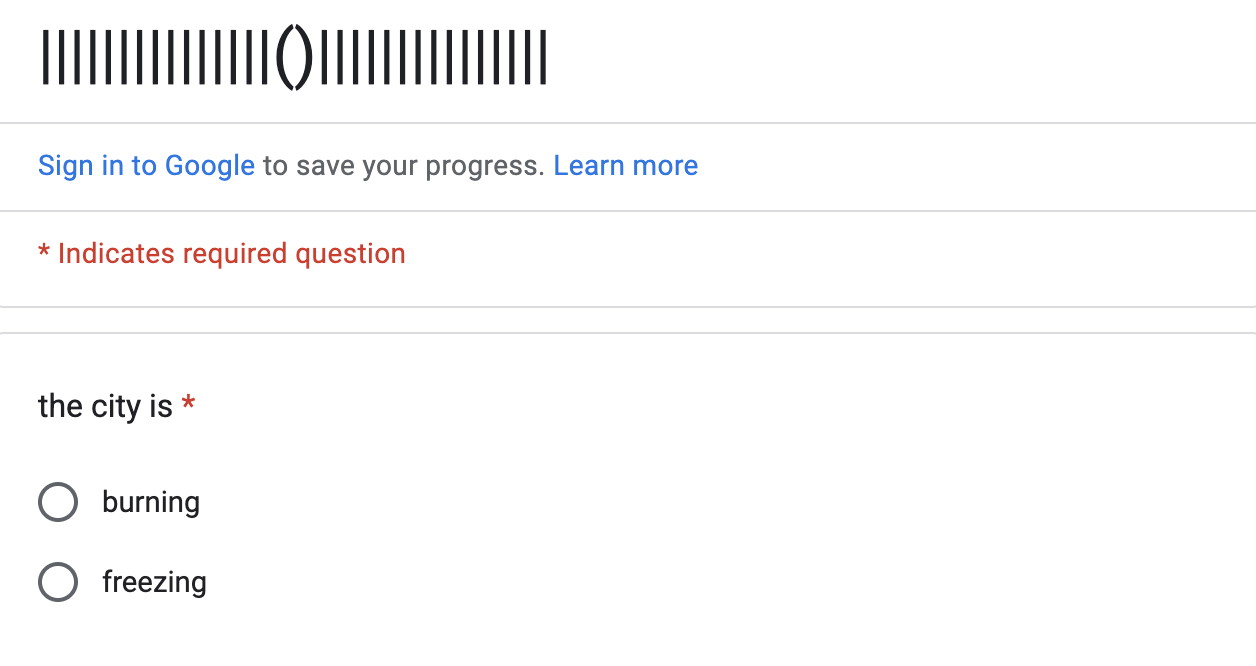
Tyler did a great job at illuminating how such a simple digital survey instrument (like the ubiquitous “google form”) can mirror the choices and micro navigations in everyday life. The piece unfolds as an interactive text in which readers click through choices that evoke the poetic disorientation amidst a fallen or doomed civilization. Rather than a traditional plot, the story is experienced as a series of associative leaps, where choices often feel less like control and more like surrender to the logic of the work’s emotional circuitry. Tyler scanned the room for your informal play-through strategies. Some of you went with what felt “right”, some chose randomly without any real conviction, some tried to build upon a loose logic of their own making. Is that how we ultimately live our lives? What Tyler made apparent was that many of these “moments of choice” were simply an illusion without much consequence. The city is always going to implode. The “choices” in the google form act as portals through shifting versions of the self, breaking with any cohesive or linear experience. In the end, we come to realize that the player’s “reading/writing” navigation mirrors the internal work of piecing together a scattered psyche. What is at stake here? Our sense of our own “cohesive self”? Free will or fate? Each click we make is both a decision and an act of reconstruction. We as readers are invited to make choices by clicking through links that seem to offer control over the direction of the story. But in the end these choices often loop back, collapse, or lead to outcomes that feel inevitable. All Our Time Tossed Selves pulls the curtain back on the illusion of agency in human life. This piece lets us know that fate is not a single, linear destiny but a looping network of multiple forms of self. Life is stringing along the many choices we make or fail to make, …each tossed through time and memory. It is a haunting piece, and Porpentine’s beautiful and wistful title, All Our Time Tossed Selves, is the key to understanding it.
Hannah Feels
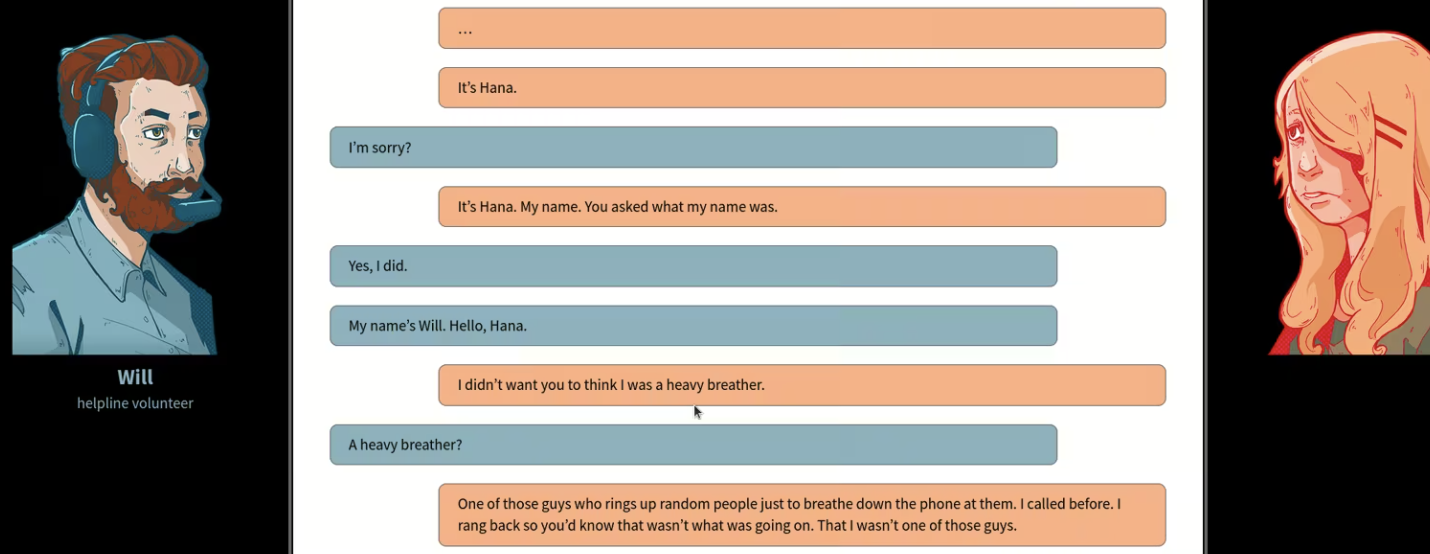
After a short break we turned to a another powerful piece of interactive fiction that uses player choice to probe the limits of empathy, agency, and control. Hannah Feels is about a young woman navigating anxiety, social discomfort, and self-doubt. By making decisions on her behalf, we as readers become complicit in shaping her emotional trajectory. To echo our discussion, we become responsible for her. We can attempt to “help” or “fix” her by navigating the interactions she has, but it soon becomes clear that these subtle interactions might backfire, emphasizing how difficult it is to impose external control on another person’s emotional reality. Thanks to Cindy for taking us through a potent and painful interface for storytelling. It was not easy to read this out loud in the room, but you did that work with all of us present and bearing witness to the acute pain of self-harm. We were confronted with the inner turmoil of self-violation by cutting. The more the reader-as-player tries to assert control, the more the story insists on the complexity and autonomy of Hannah’s inner life. In the end, our feeling of “responsibility” becomes a meditation on empathy. Hannah Feels seems to suggest that free will exists, but always within the constraints of context. That context may be mental, emotional, or even structural. We come to understand that freedom (for us as “readers” or for Hannah) is never absolute. It seems to me that both of our readings this week have reminded us that in digital narratives — as in life — choice is never as free as it seems.
For next week:
Please read Jenny’s selection: Retratos Vivos de Mama; and read Hunter’s selection: Writers Are Not Strangers.
Blog due: Blog about your reading experience and understanding of Retratos Vivos de Mama and Writers Are Not Strangers
See you in our our CAS classroom next week (11/10)!

