

Last night we concluded our Walkthrough Presentation Series. This marks the end of our “tour” of some examples of electronic literature. I am grateful for everyone’s thoughtful engagement with the selected works. I think we have received a solid “glimpse” of electronic literature’s diversity (formally, culturally, and conceptually). It is a radically open field that challenges conventional ideas about what literature is, how it is made, and who gets to participate in it. There is no doubt that digital media has expanded what counts as “writing,” and how audiences encounter it. Now we turn our attention to our own imagination(s). In the time we have remaining, you will be writing your own electronic literature. You are all invited to lean into your own creative inspiration as we move forward in the final month of class.
Our time remaining
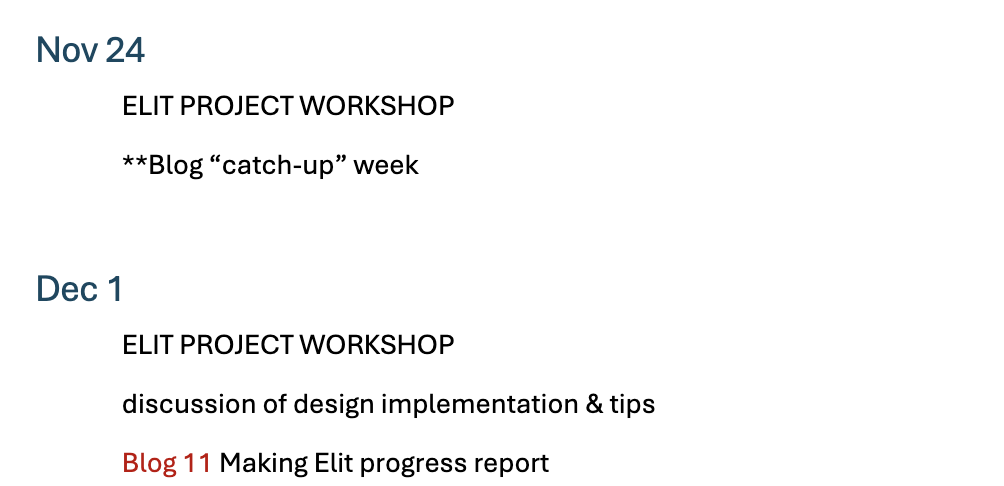
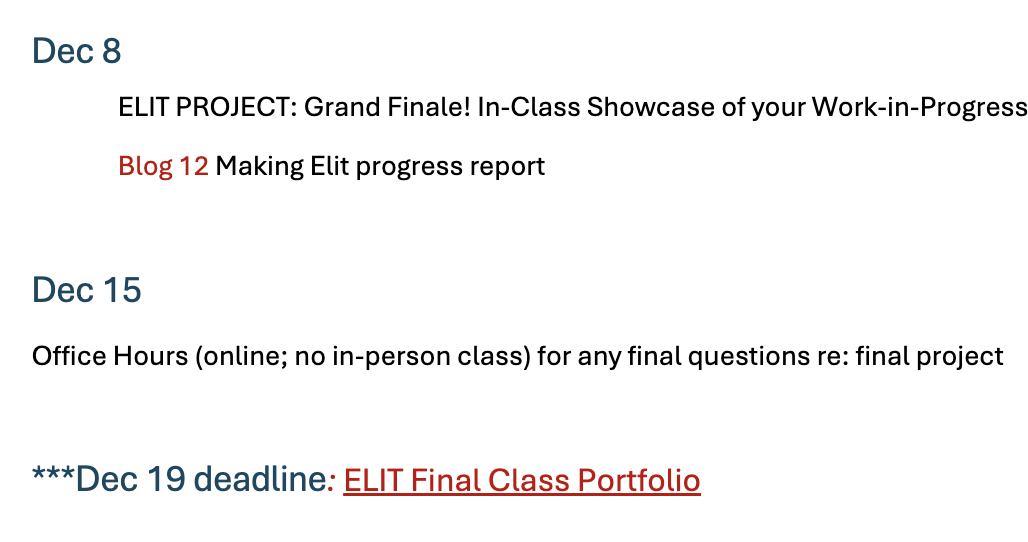
I shared our schedule “snapshot” regarding our final course meetings at the beginning of class. Please note the plans for the final phase of Elit Class:
Blackout Poetry Tool
Thank you Nas for a fun and thought provoking “spin” through the Blackout Poetry Tool by Jazer Chand. The resulting reflections regarding machine writing versus human writing were a good way to close out our consideration of elit. As a reference point, traditional blackout poetry is a creative form in which a poet takes an existing text and redacts, obscures, or “blacks out” words, leaving behind a select few to form a new poem. This established tradition already posits a “dialogue” between two writers. With Chand’s tool there is an additional expansion to this tradition of interactive co-writing. Here we encounter multiple “modes” of interaction between human and computer, making us think about the relationship between the reader (or user) and the writer (or automated/algorithmic system). Playing around with this interface definitely prompts us to think about different ways humans and machines (in tandem) transform the writing process. To generate unexpected creative connections through subtractive writing reveals surprising phrasing that the poet may not have invented consciously. This makes us think more deeply about what comprises creativity, intuition, logic, emotion, …and ultimately, intention in our writing. Rather than simply using a computer to automatically generate a poem, the tool gives us different “relational” models. It makes us confront how creativity might be shared between human intuition and algorithmic logic. The Blackout Poetry Tool invites us to think about control, randomness, and co-creation. While blackout poetry has always challenged fixed notions of authorship, this computational tool adds a new layer, making us consider what “poetry” means to us when a machine is involved.
200 Castles
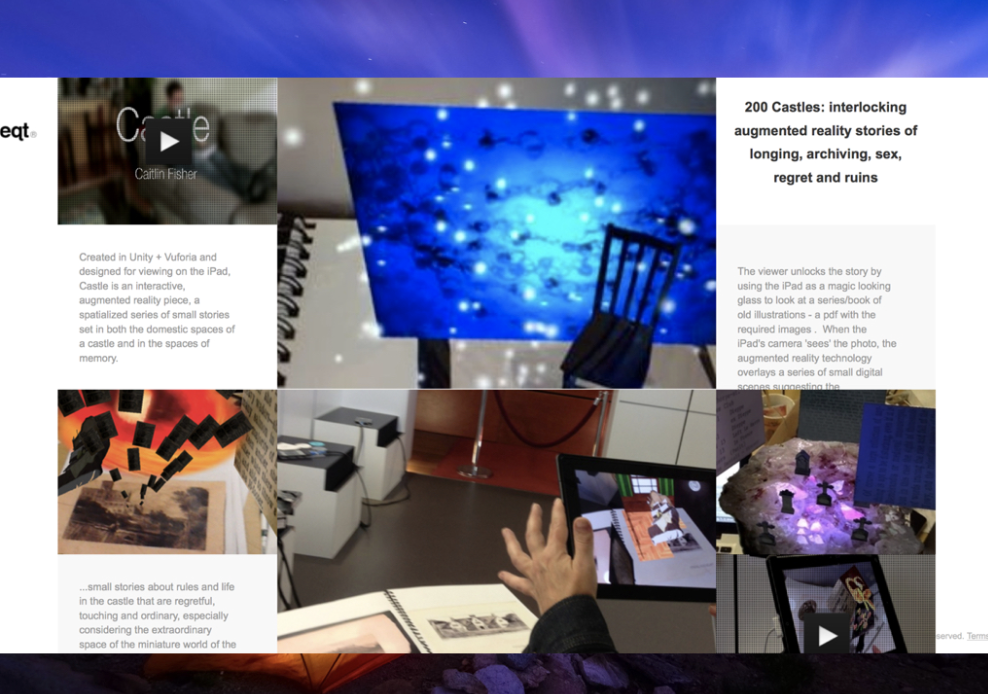
Lareice chose to present on 200 Castles by Caitlin Fisher. The work was originally developed in Unity for the iPad. I am not sure why Lareice chose this, since the work is no longer generally accessible and she herself did not access it directly.
In this augmented reality story users can unlock small vignettes by pointing their device camera at images. 200 Castles demonstrates how augmented reality can support lyrical, memory-driven storytelling through touchstone interactions. These interactions with “lexia” (words) and image are a lot like “unlocking” secret dimensions that lay just beyond the surface. In the end, the non-linear design of this piece allows for a fragmented yet resonant reading experience. It is like roaming in unending rooms in an mysterious archival castle. It seems to me that the form this augmentation takes mirrors how we remember places and histories (like piecing together shards of a broken looking glass or finding scattered pieces of an abstract puzzle).
Unfortunately, Lareice’s presentation lacked the possibility of a “walkthrough” which was the basis for the assignment. We were able to speak briefly about the way the piece was made, but we were not able to read it. Like I said in class, this is a superficial form of engagement. It is equivalent to looking at a book (its front and back cover) yet we lack the deeper knowledge that can only come from reading it. It was a disappointing way to close our overall engagement with electronic literature. At least we were able to think for a moment about the potential affordances of augmented reality in creating new story worlds.
For next week
Please write a short blog about your early ideas for your final project of your own elit. What story/stories do you want to tell? How do you imagine them unfolding? In what ways will the reader experience them, and how will you introduce a realm for reader interactivity? This blog will be a preview of what you hope to work on in our final workshops for class.

