
I am glad we started class with some opening reflections on what is possible regarding your final projects for Electronic Literature class. I hope your freewriting time and the open discussion with peers helped open up some early ideas about what you would like to make in the final stretch of Elit Class together.
Death of the Author?
In his 1967 essay “The Death of the Author,” Roland Barthes argues that the meaning of a text does not reside in authorial intention (what the author intended to say). Rather, the meaning of a text emerges from and through the reader’s engagement. In other words, the interpretation of literature belongs to the reader rather than the author. Meaning is not given by the author but it is produced by the reader. After our discussion on Monday, I started to think about the pairing of these two elit pieces with this Barthesian idea of the “readerly” versus the “writerly” text, and his well known claim that “the birth of the reader must be at the cost of the death of the author.”
Thanks to both Jenny and Hunter for their thoughtful presentations on both of these elit readings. On face value, the two works are seemingly disparate. But ultimately, they both have things to say about the dynamics of authorship and readership.
Retratos vivos de mamá
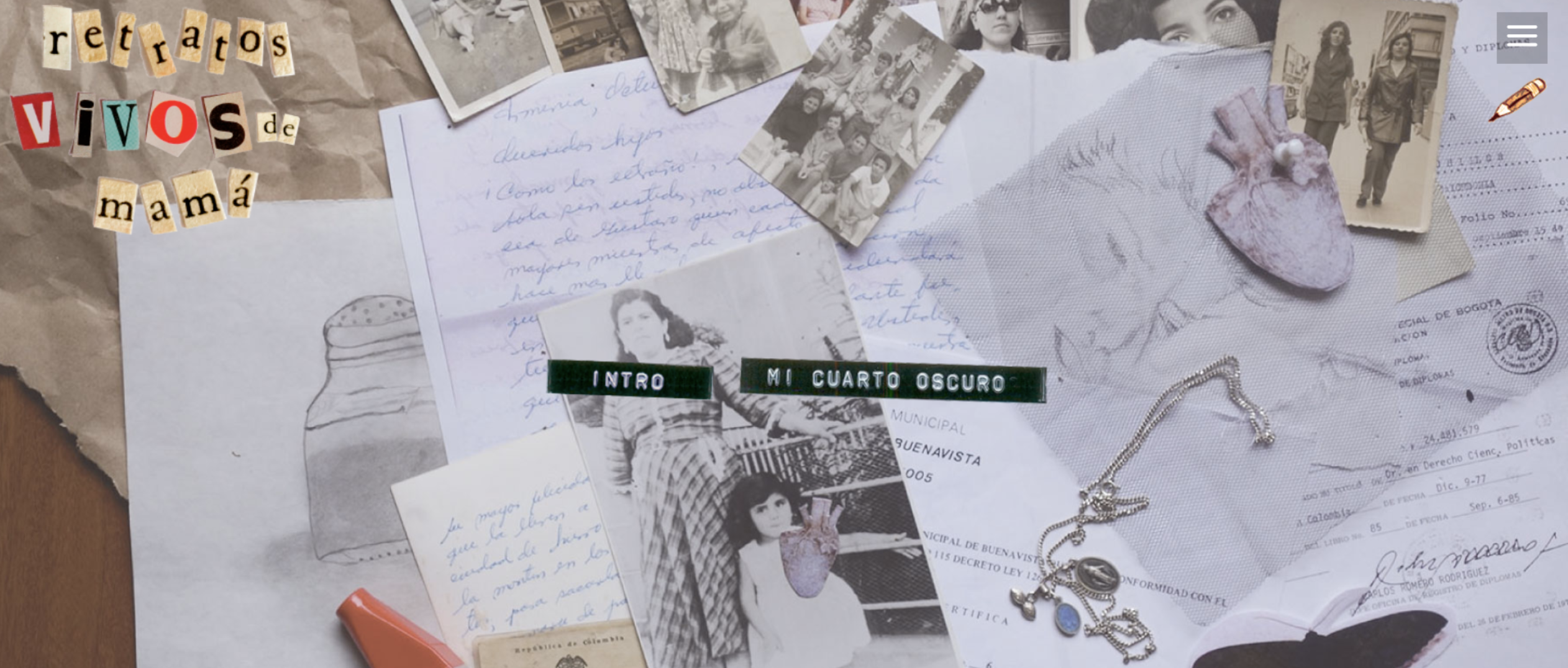
Retratos vivos de mamá by is a beautiful scrapbook and collage of personal bereavement, grief, and the intimate experience of mourning. It is a “living book” that continues to expand in time with new components to the work added as the author moves through the very personal and potent experience of grief. Photos, sketches, videos and recorded sound are layered with her own text. These sensory traces of a life stand in for Mama. Multi-modal forms of media become proxy for the body and voice that are no longer there. The layering produces a feeling of a living portrait made out of remaining objects and artifacts that her unique human life has left behind. As Jenny made evident in her walkthrough, grief is both a private experience, but here, it is simultaneously offered up publicly as a cultural object. With Retratos vivos de mamá, we are asked to believe that digital media can preserve the presence of the dead. As the multimodal artifacts let absence feel “present” in the reader’s experience, what is at stake in re-creating that presence? And on whose terms?
Writers Are Not Strangers
On the other hand, we read Writers Are Not Strangers. This is an interactive fiction in which the reader or player is asked to rate fiction fragments. In this way, the reader enters into a meta-critical “loop” about writing, judgement and audience. The protagonist Alix is a YouTuber and writer whose mother is dying. The reader rates Alix’s work and becomes a key engine in how Alix’s story plays out. The story itself blends text and interface elements like rating stars, scores, and “reader as judge” mechanics. This flips the usual power dynamic. In a traditional framework, a writer presents (and a reader consumes). But here, a reader judges (and a writer reacts). Writers Are Not Strangers connects the mechanics of judgment (you, the reader, assign scores) with the emotional consequences for the character. The fact that you-the-reader rate the fragments isn’t just a novelty. This is the message. The interface enacts a problem: writers are subject to metrics, readers enact judgment. And of course, this raises ethical questions. As readers, what responsibilities do we have?
Authorship and death in the digital age?
Both Retratos vivos de mamá and Writers Are Not Strangers examine how digital media mediate human connection, whether through memory of the dead or in relationship to the artist in a consumer-driven world. Both show how electronic literature turns interaction itself into an act of meaning-making. In Retratos vivos de mamá the “author” of meaning is not the biographical mother or daughter but the reader, who reconstructs significance from fragments. In Writers Are Not Strangers the relationship between author, reader, and meaning is dominated by ratings, metrics, and feedback loops. In the end, both readings this week make us look closely at authorship in digital contexts: one through memory and mourning, the other through metrics and mediation. Roland Barthes declared that the author must die for the reader to be born. And this week in elit class, we catch a glimpse of the fantasy of death never being final. In Retratos vivos de mamá, the author returns as an affective ghost, and in Writers Are Not Strangers, Alix survives only through the algorithmic engagement of her readers.
For next week:
Please read Nas’ selection of Blackout Poetry Tool and Lareice’s selection of 200 Castles. Please write your next blog about your reading experience and understanding of Blackout Poetry Tool & 200 Castles.
See you in our our CAS classroom next week (11/17)!

