Post-Presentation Reflection and More

Since my presentation last Monday, I have done some reflecting on The Vine and the Fish. In my reflection paper, I talked about how the story felt a bit disjointed to me but after discussing the piece with the class and hearing some insight, I don’t really feel that way anymore. I really appreciate the conversations we had in class and talking through my own thoughts and ideas. I often do come to conclusions better when talking out loud and collaborating with others. I think any feeling of disconnection may have been purposeful to fit along with the message of the piece.

I really enjoyed All Your Time-Tossed Selves! I’m looking forward to Tyler’s presentation on Monday. I went through it two different times clicking “the world is ‘freezing’ and then ‘burning'”. I had so much fun going through this and the “choose your own adventure” feeling this piece provided. All Your Time-Tossed Selves also gave me an idea for my own piece of e-lit we’ll have to do by the end of the semester. I love a choose your own adventure piece. I looked back to compare answers with the other responses which was a lot of fun. My first walk-through I picked haphazardly and the second time I was a little more intentional with my answers but not entirely. I will say the storyline isn’t so in-your-face obvious other than the fact that we are in a city that has been either burned or frozen to ruins. I can’t wait to hear more about this piece in Tyler’s presentation.

Hana Feels reminded me a little bit of All Your Time-Tossed Selves. Although you couldn’t pick every response, it still had the essence of a choose your own adventure which as I said, I love. A part of me wishes there was audio with this piece but I also kind of enjoyed imaging what the characters would sound like. I think I enjoyed Hana Feels a little more than All Your Time-Tossed Selves only because I understood the story more. I’m not sure why but I felt more responsibility in Hana Feels. I wanted to make Hana feel better and I was more thoughtful with my responses. I think this piece did a great job of displaying the complexities of general relationships especially when one person is struggling mentally. The ending I got to was that Hana went to a support group, confided in her friend and planned on confiding in her mom as well. I’m pleased with my ending! I had a lot of fun going through this piece, I almost felt like I was watching a tv show or something. I can’t wait for Cindy’s walk through!

All Your Timed -Tossed Selves & Hana Feels Reflection and Reaction

All Your Time- Tossed Selves 

The progressive Google Forms as a substrate, carrier of the dialogue and our responses is a creative interactive way that many are familiar with when filling out a survey or poll with Google Forms and providing an interest in an event or information, sign up.  The conversation happening between me and the form cerates this responsive letter with only two multiple choices lines of dialogue to choose in the beginning, but  eventually evolves to checking multiple boxes, from a drop down selection arrow, and additional multiple choice selections available to choose from that carries the conversation along making you  realize it doesn’t matter what you choose you will be back where you stated eventually. Depending on each response, the interaction finds a way to show empathy towards what selection I chose related to the question. I tend to forget about what question was asked prior as now I am focused on the present. Each response does have an effect on the following though as I move forward  with. It was clever to provide a list for me to choose from of what I brought with me in my  “small bag” going to the Tower which made me mindful of the lines provided. I enjoy being given the option of seeing my previous responses once I have submitted my current form. The biggest part of this work was the Pie and Bar graphs that were provided of all the responses with percentages of choices made. This made me feel like I am part of a larger anonymous group but somehow affecting the whole together with our choices. This is similar to how our society is here in America, we tend to think of our choices as being singular and not affecting the whole or our surroundings, but they do. If we were provided with a visual of how our choices do change or affect others. Then I think we might be deterred to make certain choices and rethink others having the opportunity to look back at the previous ones selected. Just being mindful and aware.

 Hana Feels

Reading the Editorial Statement before accessing the work of Hana Feels knowing that it is related to mental health crisis and I would be mediating what is said to her from the 4 role dialogue responses made me interested as a Veteran who has faced many “rough patches” on my own without support or having an outside perspective on its effects to the body, mind. The words of “allied purpose” are substantial and having a role to make a difference with Hana’s situation depending on what is said to her. I chose the work website version, instead of the arrive to interact as a participant, now a digital friend of Hana’s here to support her through this mental health challenge. The type of support is extremely important, and what and how we say something to someone having a mental health crisis needs to be thought through and have empathy not sympathy. Sometimes we think we know the best things to say to someone in a time of need, but they don’t always have the effect of making the person in need of support feeling any better from what was said or advice. In a way you are playing an active menta health negotiator and trying to help a friend. Peer, coworker, family member out of a situation that has overtaken their mind, feelings, thinking and get them into a more level, stable way of thinking and reacting to what is happening. We must be aware of the mental health part of the formula when trying to share care; understanding there is an imbalance. In my experience as Will the Volunteer I asked the question “what is your name” it seems that there was pause in any responses to be made after that, the selections became limited. There was quiet breathing then click. I thought by asking the name of the caller would create a more personal feeling, showing I understand another human being is on the other side needing help. So I decided to interact again, clicking the refresh button bringing up the same helpline scenario page and responses to what I could ask the caller, Hana. This time I asked, “Is there something you’re worried about?” Once again some gaps in the responses boxes and quiet breathing resulted making me feel like I asked the wrong question to her. It’s interesting that when I clicked on Will the volunteers profile it mentioned that he is “worried of saying the wrong thing” to the caller. I also felt this anxiousness or weight on my consciousness while interacting with Hana. Realizing that Hana actually hung up during the previous call not because I asked the wrong question, but because she was concerned that I would think she was a “heavy breather” caller doing it as a prank, or for one’s own enjoyment. This made the interaction even real for me and created a responsibility in me to continue speaking to Hana. Hana’s Journal was insightful reading her feelings calling up the help line and understanding her thoughts or reasoning. The discussion playing the role of Christine, Hana’s boss created a entirely new feeling towards my role. I assumed that this would be about how Hana’s mental health was effecting her productivity at the Casino. I selected responses back to Hana that were from a understanding nature of one who has dealt with mental health getting in the way of my job performance, instead of other responses that were cold and not caring, but focused on assertiveness and putting Hana’s mistakes in front of her not really understanding first what was going on with her. I learned ones role, title, responsibility towards a individual whether a boss, friend, co worker, family member would require a different level of concern and empathy felt with something so delicate and quiet as mental health.

Hana Feels

Paper: Cindy Rodrigues Formal Paper

Presentation: Hana Feels

All Your Time Tossed Selves

I can finally say I have a read a story through Google Forms. From past few semesters, Tyler has always had such amazing presentation’s and always has such great picks. I knew getting into this Google Form read, it was going to be very exciting and very different in a good way. Before you even start the piece, if you’ve used Google Forms before, you know you are usually met with a choice of some sort. The “choice” concept of this interactive piece is pretty on theme with Hana Feels! It was nice to step away from Hana Feels and enter a new world of choice. With All Your Time Tossed Selves you get a choice but the ending sort of remains the same. What is different about this piece, is that whatever you click will dig you deeper into the experience. I guess I would call this a reflective piece due to the nature of this “Dying City” and the narrator is reflecting their past in a sense. At the end, I did appreciate the glimpse into the data collection of the 11,000 folks who have participated. It was interesting to explore our collective choices and it made me want to play the story over and over again for a new but “shared” experience.

What we see, and what we choose not to see…

I really enjoyed our discussion this week. The “walkthrough” presentations by both Ava and Emily had us thinking together in new ways, and I think the pairing of Ava’s presentation on Ask Me about the Moon, and Emily’s presentation on The Vine & the Fish also yielded a dynamic and thoughtful discussion. As we continue to proceed through our class together, I have noticed the way in which each week’s selections either match-up or mash-up in ways that draw out deeper understanding of electronic literature. In other words, the randomness of “the presentation roster” has somehow yielded new meaning for me, as we take in each new text in unforseen pairings.

Ask Me about the Moon

Thank you for a wonderful presentation Ava on a piece that has always been a personal favorite. Perhaps it is the special blend of beautiful lyric, stark image, ethics, scholarship, and cultural critique, all blended with certain subtlety, that have always spoken to me regarding this elit piece by John David Zuern. Ask me about the Moon evokes the hidden labour and infrastructural underside of tourism in Hawai‘i, and like the timeless tides of the ocean, it brings us in and out of the problematic layering of tourism, labour, and invisibility. Here, Hawaii is not just a scenic fantasy backdrop, but conceptual frame. Tropical leisure is juxtaposed against service industry labour, and we as readers are invited to reflect on the hidden damage of tourism economies, infrastructural degradation, and the poetics of place. I appreciated how Ava had us pause to consider the rhythm and effect of Zuern’s lyric form. Her analysis of how incorporated sounds, the actual rhyme scheme, and the lyric tone itself, mirrors the ebb and flow of repetition (and even exhaustion). We are forced to reconsider our “tourist gaze” and think about what we choose to see as opposed to the reality of an imbalance (rooted in unseen work and ecological pressures). It is a powerful and complex piece of art, and Ava helped us all see that effectively.

The Vine and the Fish

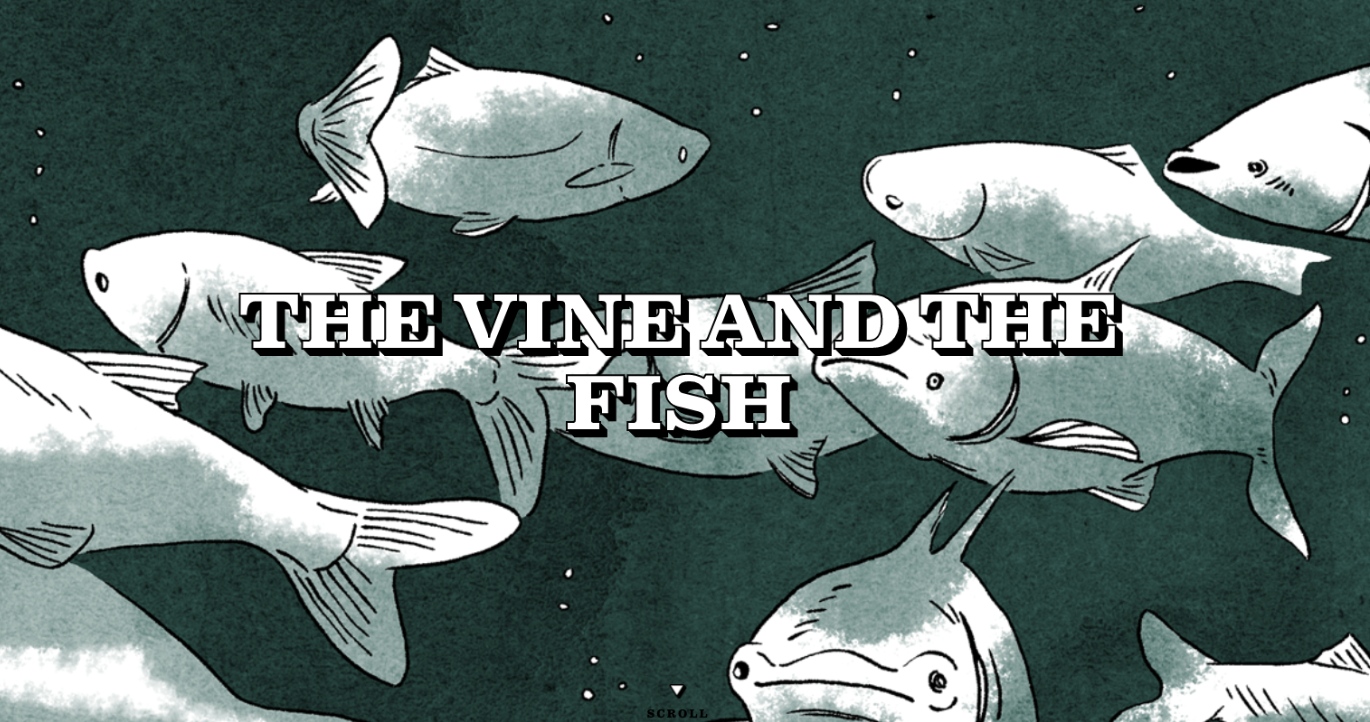
Emily’s presentation was a perfect “Part 2” of our class with her walkthrough of The Vine and the Fish. This work also draws on ecological metaphors (invasive vines, imported fish) while connecting these ideas to the protagonist’s embodied experiences of othering. Sentences are often spare, at times fragmentary. The color palette is a subtle and soothing celadon green. The piece itself could even be called gentle. This simple yet profound web comic is a reflection on migration, belonging, and how language and classification can render people (especially Asian diasporic subjects) as visible or invisible. The vine’s creeping growth and the carp’s invasive reputation function as “double-speak”. On the one hand they are ecological descriptions (kudzu, silverfin, etc.), and on the other hand they are racially inflected metaphors about immigration. The Vine and the Fish foregrounds acts of seeing and being seen. And it makes us all see that the language of classification also does ethical work. Emily’s presentation was especially effective when she juxtaposed her “live” walkthrough of the interactive piece with a rendering of the “pdf” version (the static panels of the web comic). This helped us understand the affordances that come with interactive elements in elit (even if quite simple ones like in this piece). We agreed that the elit version of this story feels more like a journey through time and space, embedding both personal and political reflections as they leap off of the screen.

Visibility & Invisibility

Both of the elit reading this week engage with what is made visible and what is kept invisible. Through web animation, scrolling, layered text or imagery they make apparent the problems of hidden labour, hidden identity, and ultimately, hidden power. These two narratives have both used digital interactivity to emphasize what is visible while concealing and/or revealing something deeper. That mix of surface appearance vs. underlying reality is what impacted me as we looked at these two pieces together.

For next week:

I look forward to the presentation by Tyler on All Your Time Tossed Selves  and the presentation by Cindy on Hannah Feels.

Please read both pieces for next week, and blog about your reading experience.

Happy Halloween!

See you in our our CAS classroom next time (11/3)!

All Your Time-Tossed Selves & Hana Feels


All Your TIme- Tossed Selves

I knew from small tidbits of Tyler’s comments in class that his work dealt with a GoogleForm. I didn’t know what exactly that would entail, so I am happy I let myself wait until this week to actually see what he meant. Man, I had no idea what to pick for every single question.

At first, I didn’t really know what I was doing, or what I was picking for. I understood that I was in some city that had been ruined, but I didn’t know why or what ruined it, why I was there and what I was meant to do. But, I think that it really worked well, as when we hear stories of heroes trying to mitigate damage and attempt to pick up a community from its scraps, they don’t really know what they’re doing either, really. When faced with a situation like this, we can only hope we are doing the right thing. We never know if the choices we made were the “correct” or “incorrect” choices, but rather that they were the choices we felt compelled to choose in that moment. That’s how I felt moving through this piece.

I actually took my time with it, too. In the description, it states this only takes about 2-5 minutes to move through. Though, I took about 15 minutes to go through it. I wouldn’t say I was overthinking my answers, but rather thinking through them clearly and predicting what would come next. A lot of the choices I picked because they related to me and my current interests. For example, the “question” of, “so gather up your things as the city crumbles around you. what did you bring?” I chose the first answer simply because it mentioned a bird. Recently, I have felt very connected to birds, so I picked that one because it talked of an “amber bird” that the reader needs to hear it sing one more time. Another time this occurred was for the question, “did you notice yet? this life isn’t done with you,” to which I chose, “and we talk again like old friends,”. I picked this one because I’ve recently been thinking about a close friend growing up that I drifted apart from.

So for me, this was really cool to just insert myself into a narrative that I didn’t recognize at all. It was cool to just step back from my real life and twist it a bit to fit into this ruined city. It was great to just not be me for a few minutes.


Hana Feels

Before I began to work the website, I was immediately nervous. When I feel nervous, or any kind of emotion, I feel it right in my heart rather than my head or anywhere else. So, when I read that this story can end in three ways, I immediately worried about the way I would point Hana to. The first point I brought her to was hanging up. This <click> came after I asked for her name. How interesting that this one thing we’re assigned right away and that stays with us for a long time (whether one chooses to keep that name or not) can create a space for such discomfort. It’s interesting how much weight we put on a name.

I then picked all the options which all ended this way. I was really disheartened by this because sometimes, not matter what you say, the other person may not be ready to receive it. It’s one thing to pick up the phone and dial, but it’s another to actually begin talking. It’s all really difficult. But then, I found the hidden hyperlinks, which took me to Will, who keeps saying he would be there for as long as it takes. I found that quite beautiful and sincere. I went through some more conversation with Hana, which ended a bit after her description of the woman in the casino. I sincerely hate saying the wrong thing all of the time, so it’s really interesting to have this heightened sense of that when put in a situation where you are talking to someone who is feeling vulnerable and a bother.

Moving through the story, my version of Hana was able to open up about her troubles to Will, Jen, Christine, and Ernie. My ending was a bit of a cliffhanger with her mother, and how they would soon meet to talk. We cannot be sure if it’s to talk about her behavior or something else, but it seems that Hana will confront things that have been bothering her. This work took me about 45 minutes to work through because of the deep reasoning I made myself go through each time I chose a response. I don’t think I will work through this one again, at least anytime soon, because of personal effects. But, it’s a really interesting simulation that anyone can learn from. It forces you to either choose or abandon empathy. I hope everyone chose and continues to choose empathy.

Exploring Digital Resistance 

Ask Me for the Moon

While moving through Ask Me for the Moon, I couldn’t help but think of Bad Bunny’s song “Lo Que Le Pasó a Hawaii”, a critique of colonialism, overtourism, displacement, and the loss of cultural heritage due to foreign interests—issues that also affect his home country of Puerto Rico. The piece itself moves quickly, the words phasing into one another, demanding close attention. I actually found myself screen-recording my navigation through it just to revisit and unpack the experience.

Certain phrases stayed with me: “all work is night work” and “guest approaches host, nature divided by work.” These lines expose the tension between pleasure and labor in spaces like Hawaii, where tourists seek rest and escape while forgetting they stand on Native land—served by the very people whose culture has been commodified.

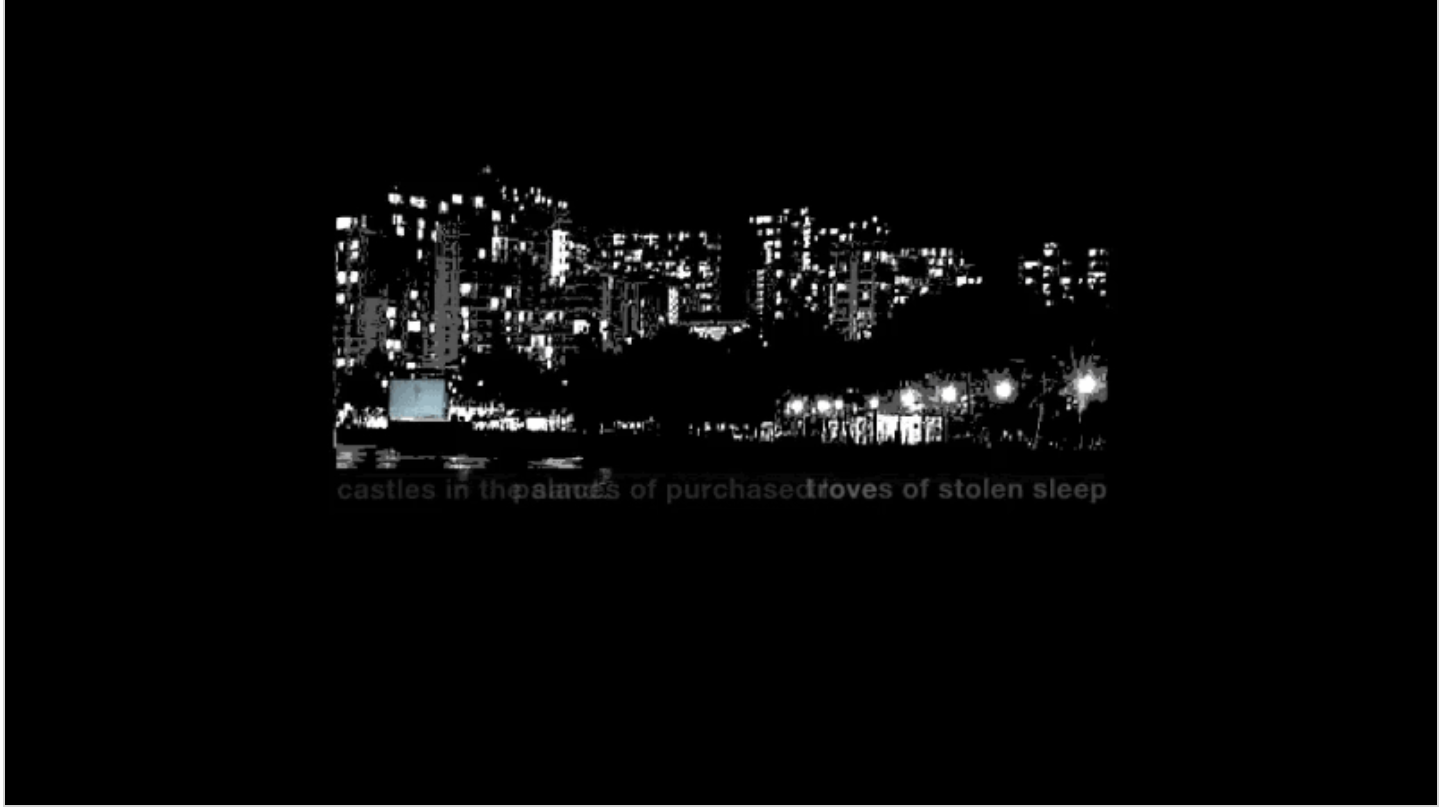
As the poem concludes, Waikiki’s skyline fades into view. Instead of the bright, colorful image one might expect, it appears in muted shades of black and gray, metaphorically representing exhaustion and the invisible labor sustaining Hawaii’s tourism industry. Beneath the skyline, a collage of images emerges: photos spelling out “Waikiki,” a palm tree, waves, and a figure standing before the ocean. The sound accompanying these visuals—whether heavy breathing or crashing waves—evokes both the persistence of life and the suffocating labor rhythms described throughout the piece. The repetition of the word breath reinforces this duality between survival and exhaustion.

As readers, we become participants when clicking through the images, choosing our own paths and uncovering layers of text and turquoise words. These fragmented poems expand into longer reflections on Hawaiian culture, revealing the state’s control over Native rights and traditions. We learn how beaches celebrated by tourists are often inaccessible to locals, and how the hospitality industry depends on unseen nighttime labor. Through this structure, Zuern forces us to confront the hidden costs of leisure—the people who work tirelessly to maintain the image of paradise.

The Vine and the Fish

Scrolling through The Vine and the Fish felt like moving through a living archive—stories of men and women intertwined with species like kudzu, mosquitoes, lionfish, and Asian (Silverfin) carp. Each was brought to America for a purpose, only to be labeled “invasive” once their presence grew inconvenient. This dynamic made me think of indentureship and slavery—the way Asians and Africans were brought to the Americas to build railroads, cultivate fields, and provide labor, only to later face exclusion and segregation.

The piece’s language stood out: “good = native and bad = invasive,” and “real is the human desire to create order by imposing clean categories in an untidy world.” These phrases reveal how fear and hierarchy shape both ecological and social systems. The line “Fear of the body being invaded by contagion, fear of the nation being invaded by outsiders” draws a striking parallel between environmental discourse and xenophobia.

The poem critiques how society uses foreign species—and by extension, foreign people—until they no longer serve its purpose, at which point they’re rebranded, excluded, or erased. The discussion around renaming Asian carp to Silverfin mirrors this impulse to reframe what’s uncomfortable to suit a more palatable audience.

One line made me laugh in recognition: “There’s some resistance in the U.S. because we don’t like the bones in our fish.” I’ve been eating fish with bones since I was five and never thought twice about it. That simple line underscores cultural difference—and the privilege embedded in what gets accepted, rejected, or renamed.

Both Ask Me for the Moon and The Vine and the Fish use digital form to challenge readers to think about power, belonging, and the unseen consequences of consumption. Through interactive movement and layered text, they remind us that art—and resistance—can live in the space between click and breath.

The Vine and the Fish & Ask Me For the Moon

For this week’s readings, I started with Leise Hook’s graphic novel/ short comic The Vine and the Fish. Now to out myself as a bit of a nerd, I love comics and graphic novels. Seeing the bridge being built between narrative and art warms my heart every time. Hook’s work did its job in that regard. I do have to say that weirdly enough, I preferred reading Hook’s comic in its standard format, (the downloadable version) compared to the motion comic that is available on her website. I felt that that animations throughout the work got in the way of the word on the “page”. (I feel like an old man yelling at the cloud in writing this). I do have to say that the animation, and the art especially was amazing and fit into the story she wanted to tell. The use of different shades green to fit into the motif of nature and foliage was a fantastic touch. The overall narrative was compelling. It was a bit less personal that I had initially thought it would be. Despite this, when the author made the connection to the Kudzu plant and herself, the moment stood out very well. When the author wrote, “Because I’ve internalized the language of invasion biology”, my ear perked up a bit. I felt that this was a very powerful line after a lot of exposition about the dynamics of invasive species and the language and actions that surrounds them. Another thing to note about this work is the fact that it did not work correctly on my computer. I had to read the work as a static page (like a traditional comic or graphic novel). I then went on to watch a video of the work to see it in an “E-lit” context. I just thought that it was interesting how comics and seemingly straddle the line between E-lit and more conventual literature. In my personal opinion, nothing hits better than turning the page of a comic but reading them online can add levels of animation and other artistic qualities that can enhance the experience. I will stand on my soapbox all day and argue that comics deserve to be read in their paper format, but this work gave me a bit of a new perspective.

            The second work that I read through for the class was Ask For the Moon, by John David Zuern. I again, want to revel something about myself in this blog (I know it’s crazy). I need to admit that I am poetries biggest hater. A lot of my hard feelings come from the idea that I “don’t get it” a lot of time. As I’ve gotten older, I have started to have more of an open mind about poetry and its many works. I even found a handful of poems that I actually like (Much Madness is Devine Sense by Emily Dickenson comes to mind). I can say this work does not make that list. To give some credit, one line that caught my attention was, “In Frigid kitchens, in fluorescent corridors, all work is night work”. Beautiful stuff, no notes. Moving one, some things I did like about the work was how it was presented to the user. The words come in quick and fade away, maybe pointing to the forgotten and overlooked people who make the tourism industry possible within Hawaii. The imagery was small but was impactful. Also, the detours to more academic writing from other authors was a great artistic touch. One last note I want to make is about the navigational aspect of it. Since the words are fading it black and even overlapping the new words on the page, some of the poetry was hard to read and follow. Overall, this was not one of my favorites, which sucks because I can feel that this author had a really nice story to tell. Also, quick note, this work reminded me of the first season of the first season of the HBO hit show, White Lotus. They talk about similar ideas.

Ask Me For The Moon & The Vine and The Fish

Both of these pieces visually sadness. The Vine and The Fish describes the feeling of being out of place. I related to the poem the piece opened with, describing moving right before high school.

I sort of experienced this feeling the other way. Right before high school, I moved to China. I also felt very uprooted and out of place, but not in an unwanted and ostracized context. It was a strange feeling being able to relate to the piece in such a half-hearted way.

It made me more engaged in discovering moments I hadn’t had, moments of racism and alienation. The reality for many people. These feelings are important to encapsulate in art to allow others a glimpse into their world, demonstrating how ostracization effects people.

Ask Me for the Moon shows the dark underbelly or resorts and how outsiders take advantage of native land and people for profit. You click through a poem on a black screen as a black and white image of the resort flashes behind the words.

It is sad and ominous. The author’s diction feed into these tones, talking about the resort being held up by the muscles of the natives and living parts of the reef.

Hooks Work Elaborates Liberation, Categorization, and Migration

Leslie Hook’s” The Vine and The Fish “and John David Zuern’s “Ask Me for The Moon where he created with Adobe Flash-based digital poem, which is Zuern’s piece, and Web-based interactive poetry which is Hook’s piece. I find them both fascinating to read, to navigate through the click of a mouse. Both are digital storytelling, which are social analyzed. Hooks work elaborates liberation, categorization, and migration, and Zuern’s work is Hawaii’s tourism industries, hidden labor. The visual imagery of the stories was poetic, and 3D visual effects. Words that leap off the page leave you confused because it occurs unpredictably. The sound effects were a little haunting, and confusing. Hooks colors were gray, and Zuern’s colors are black, white, and turquoise. Digital storytelling is what makes electronic literature so unique and again fascinating; the entire world today is reading online, about every headline you can think of, and is always appearing to look downward, towards their cell phone for the latest hot topic headline online. This is all related to exciting digital storytelling, which is electronic literature.

Ask Me About the Moon & The Vine & The Fish