It’s hard to believe we’re already approaching the end of another semester. As I reflect on my E-lit final project one thing becomes clear: memory isn’t linear. It jumps, fragments, and lingers in unexpected ways. That’s the kind of story I want to tell. This semester has shown me that digital literature can capture that messy, layered experience something print alone can’t fully achieve.
My project is inspired by Retratos Vivos de Mamá, a piece that moved me deeply with its mix of archival materials and the intimate way it explores mourning. I imagine creating a digital “darkroom” filled with memories connected to my sister’s car accident, my family, and the ways grief and healing have shaped us. Instead of a traditional narrative, users would explore floating images, letters, voice notes, and short written reflections. Each artifact would develop as the reader interacts with it slowly coming into focus.
I want this project to be something you don’t just read, but enter moving through it with curiosity, softness, and maybe even a little discomfort. The interactivity won’t be about solving puzzles but about navigating a space that gradually reveals itself, like wandering through memory or choosing which emotional piece you’re ready to engage with. I’m excited to workshop this idea in our next class, and see how it can grow into a digital story that makes memory, emotion, and interaction feel alive.
I made this in Google Sheet. I was inspired by All of Your Time Tossed Selves and how the author took Google Forms and made a poetic narrative out of it.
The reader will navigate the piece by clicking on the boxes within the ice berg. Each box will link to another sheet on the same workbook and will contain some sort of poem. You will be able to go back to the iceberg once you are done reading the poem.
You can click on the boxes in any order. They will tell a story, but not a linear one. It’s basically about a person who commits suicide and their life experiences are the ice berg. The things above the water are what suicidal people show to society and the things underneath the water are what they don’t show people. Note how just like real icebergs, there is more under the water than above.
This is meaningful to me because my best friend commited sucide about 5 years ago and it has deeply affected me ever since.
I am excited to use a boring and professional medium like Google Sheets to make something fun. Spreadsheets are seen as corporate and uninspiring, so just like All Your Time Tossed Selves, I get to rewrite the narrative on how you can use something like Google Sheets to tell a story in a non traditional way.
For my final e-lit project I plan to create an interactive story using Twine. I sort of went down a rabbit hole on topics and platforms to use to help me with interactive stories because I really want to make a good story. After being exposed to so many creative writers, I have this yearning to create something with electronic literature. Twine is a website where it allows texts to pop up and jump into a new page after clicking it which feels like a perfect way to capture the topic. My topic focuses on how it feels like to live with anxiety and OCD. For example for me, when I fixate on something, it becomes almost impossible to focus on anything else. The words in my head become louder and more frequent, and also more repetitive. I want to use Twine to recreate how words suddenly appear in my head and redirect the reader back to the same place because thats how it feels like for me when I am overthinking about something. I would want to call this piece a “Mental landscape” because that’s essentially what it is. I am taking the reader into the mind of someone with anxiety and OCD..keep in mind… mental health looks different for everyone. I want the readers to feel the chaos, the fixation, the difficulty of grounding oneself. I believe Twine would be the best platform for me to use since it offers clickable texts and will sort of show how “spiraling” feelings like in a sense.
Some early ideas that have been generating since last class towards the final elit project is possibly creating an interactive poem that uses word scape movements on the screen with animation tools in a Microsoft WordDoc. There seems to be many options to animate text, images, using this platform and turn into a creative way to experience my poetry and also interact with it. I was thinking about creating some letters in Adobe Illustrator using clipping mask technique to add an image inside each letter that is associated with emotions, or events. Not really sure yet. Then export into a Word Doc which you can do as a JPEG or PNG file image or even with Adobe Acrobat using the “Export to Word” command.
I would really like to sharpen my skills again in Adobe After Effects but there may not be enough time to rekindle and do what I have planned creatively to the letters. Mister Horse is a free program extension of Adobe After Effects that gives you options of making text animated in various ways. I would like my poem to be in a way a task for the reader to transcribe the words or letters that show up on thw screen at variables in different colors, sizes, sequences compared to mine that was separated prior at a given point of time. This process can attempt to recognize the order of how we put words together to express a thought, emotion and our thought process contemplating our structure of putting things together, so they are comprehended by others . Meaning Making of words. There is also an effect called Clipping Mask mentioned earlier that can replace the inner part of a letter character, number with an image. This can be an effective technique also I may want to experiment with to emphasize certain particular words with a feeling.
I was also thinking about doing cut outs of letters and some images I have or digital artworks to add to the animations in a Word Doc being untraditional to how this program is usually used to communicate. Though this is too ambitious at this point of the Semester and would require too much time.
I have been playing around with an idea for my final project that I think I could have a lot of fun with. I want something light-hearted and fun/silly. The idea follows four roommates one of which received brownies from his grandma. He makes it very clear to his roommates that they are not permitted by any means in any circumstances to touch the brownies. Lo and behold the brownies are eaten and the piece will follow the roommates stories on what they did that evening to have the reader figure out who dunnit. My goal is to having something fun for readers to experience.
I also had been playing around with ideas of a he said/she said story story told in two different perspectives. I want one story to be told with traditional black text on a white screen and the other to be told an inverse of white text on a black screen. I am not the most technologically savvy person so my biggest concern is not the creative piece but the execution of it. I hope to workshop ideas on how I could execute my ideas in a semi easy way while maybe learning a new skill or two.
I’ve had the idea for my final project for a little bit now. This semester, I’ve been living in a new space, so a lot of the last four months has been dedicated to not only researching and writing for the requirements of this program, but also for learning about the environment around me. Because of this, I have been writing a lot about the birds I’ve been seeing. Writing this out, I find it quite odd. Though, It’s something that I have been really enjoying. With each passing day, the number of birds I see are less and less, and that makes me sad. It makes me feel a bit like Tony Soprano, when he becomes depressed after the ducks leave his pool.
So, I have quite a bit of poetry about these birds. Specifically, haikus. So, what I’m thinking is doing some sort of hyper-text poetry with my haikus, and maybe throw in some tankas. Overall, I want all the poetry to have some kind of syllabic format. So, I’m thinking the haikus will see these birds throughout the seasons. Four sections, maybe three to four haikus per season, with a tanka to indicate the changing of seasons. Thus, it will be narrative driven, as it follows a sort of environmental sequencing, and it will also follow the same kinds of birds.
I have not started building the website yet, but I am gathering all of my bird-related haikus. I know I will have to compose some tankas about the seasons themselves, but I’m not worried about that. Overall, I’m just thinking of what the website will actually look like and how the hyperlinking will work. I really enjoyed the simplicity of Twelve Blue with its quiet background. I think I will replicate that in a way that complements my work. I want the work to speak for itself and not let random effects override the meaning of the haikus. Also, I am not that great at detailing digital spaces, so I will see how far I can push myself.
Last night we concluded our Walkthrough Presentation Series. This marks the end of our “tour” of some examples of electronic literature. I am grateful for everyone’s thoughtful engagement with the selected works. I think we have received a solid “glimpse” of electronic literature’s diversity (formally, culturally, and conceptually). It is a radically open field that challenges conventional ideas about what literature is, how it is made, and who gets to participate in it. There is no doubt that digital media has expanded what counts as “writing,” and how audiences encounter it. Now we turn our attention to our own imagination(s). In the time we have remaining, you will be writing your own electronic literature. You are all invited to lean into your own creative inspiration as we move forward in the final month of class.
Our time remaining
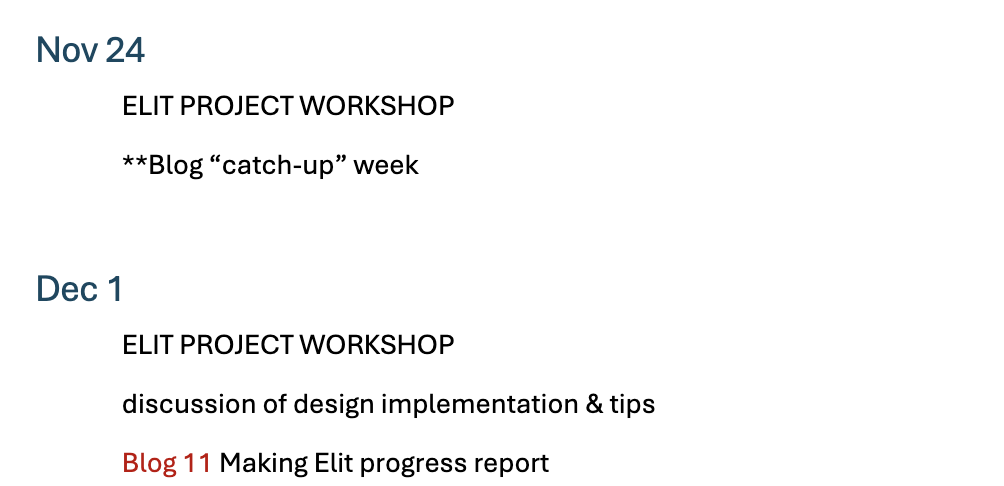
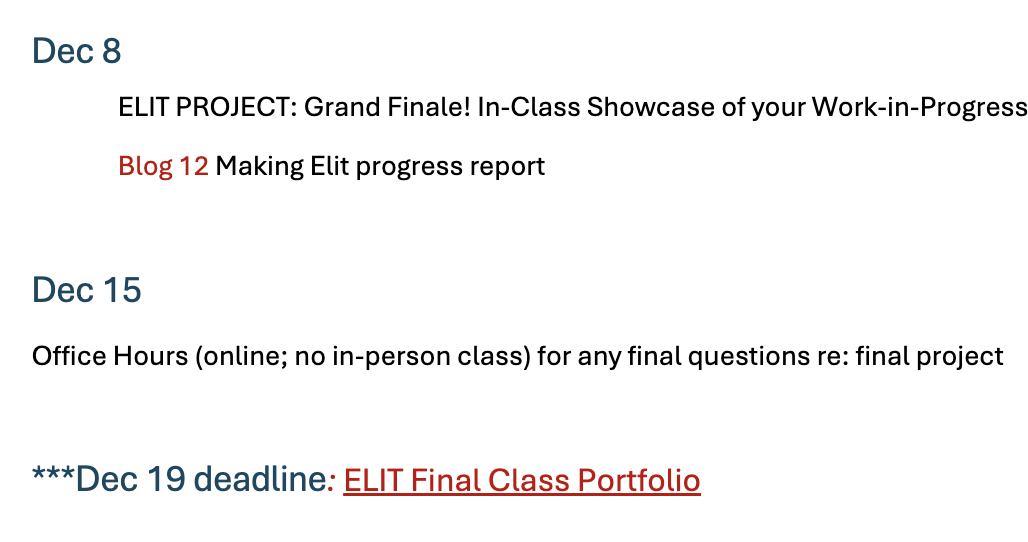
I shared our schedule “snapshot” regarding our final course meetings at the beginning of class. Please note the plans for the final phase of Elit Class:
Blackout Poetry Tool
Thank you Nas for a fun and thought provoking “spin” through the Blackout Poetry Tool by Jazer Chand. The resulting reflections regarding machine writing versus human writing were a good way to close out our consideration of elit. As a reference point, traditional blackout poetry is a creative form in which a poet takes an existing text and redacts, obscures, or “blacks out” words, leaving behind a select few to form a new poem. This established tradition already posits a “dialogue” between two writers. With Chand’s tool there is an additional expansion to this tradition of interactive co-writing. Here we encounter multiple “modes” of interaction between human and computer, making us think about the relationship between the reader (or user) and the writer (or automated/algorithmic system). Playing around with this interface definitely prompts us to think about different ways humans and machines (in tandem) transform the writing process. To generate unexpected creative connections through subtractive writing reveals surprising phrasing that the poet may not have invented consciously. This makes us think more deeply about what comprises creativity, intuition, logic, emotion, …and ultimately, intention in our writing. Rather than simply using a computer to automatically generate a poem, the tool gives us different “relational” models. It makes us confront how creativity might be shared between human intuition and algorithmic logic. The Blackout Poetry Tool invites us to think about control, randomness, and co-creation. While blackout poetry has always challenged fixed notions of authorship, this computational tool adds a new layer, making us consider what “poetry” means to us when a machine is involved.
200 Castles
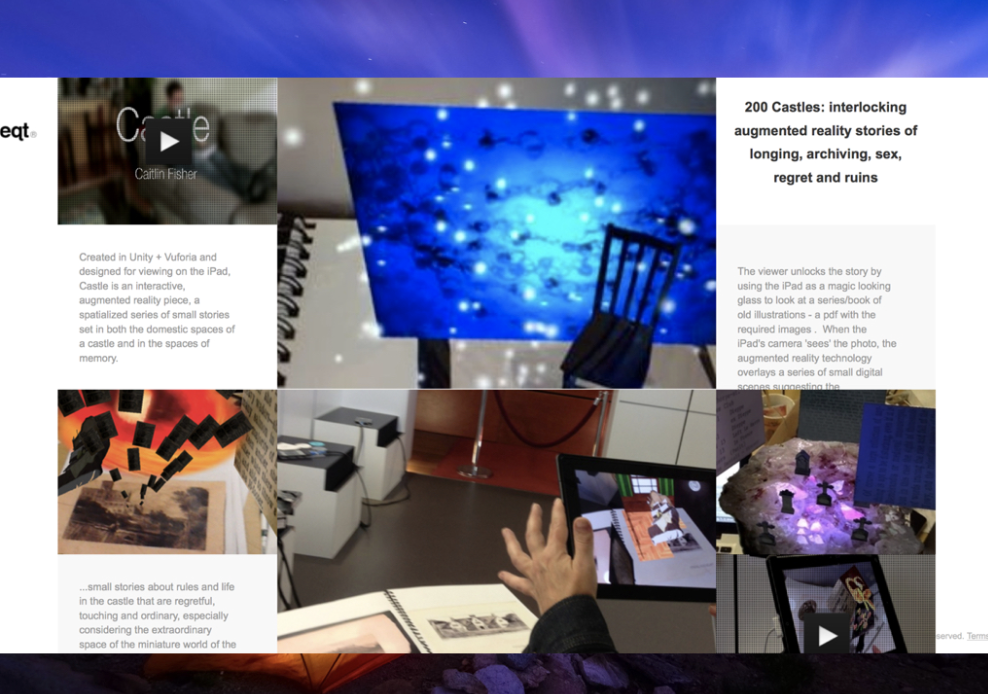
Lareice chose to present on 200 Castles by Caitlin Fisher. The work was originally developed in Unity for the iPad. I am not sure why Lareice chose this, since the work is no longer generally accessible and she herself did not access it directly.
In this augmented reality story users can unlock small vignettes by pointing their device camera at images. 200 Castles demonstrates how augmented reality can support lyrical, memory-driven storytelling through touchstone interactions. These interactions with “lexia” (words) and image are a lot like “unlocking” secret dimensions that lay just beyond the surface. In the end, the non-linear design of this piece allows for a fragmented yet resonant reading experience. It is like roaming in unending rooms in an mysterious archival castle. It seems to me that the form this augmentation takes mirrors how we remember places and histories (like piecing together shards of a broken looking glass or finding scattered pieces of an abstract puzzle).
Unfortunately, Lareice’s presentation lacked the possibility of a “walkthrough” which was the basis for the assignment. We were able to speak briefly about the way the piece was made, but we were not able to read it. Like I said in class, this is a superficial form of engagement. It is equivalent to looking at a book (its front and back cover) yet we lack the deeper knowledge that can only come from reading it. It was a disappointing way to close our overall engagement with electronic literature. At least we were able to think for a moment about the potential affordances of augmented reality in creating new story worlds.
For next week
Please write a short blog about your early ideas for your final project of your own elit. What story/stories do you want to tell? How do you imagine them unfolding? In what ways will the reader experience them, and how will you introduce a realm for reader interactivity? This blog will be a preview of what you hope to work on in our final workshops for class.
I don’t enjoy the bot helping me create the poem. It doesn’t match the theme that I’m trying to run with when I make my choices. I do like the concept of a digitalized blackout poem software because it makes the art accessible to those who might’ve never known about it from anywhere else and people who struggle with fine motor skills (handwriting). I’d like this much more if the bot was removed and the original pieces were longer or from contemporary works. I don’t particularly feel inspired by Nick Carroway discussing West Egg.
I reserve my judgements about 200 Castles because I couldn’t find the app that would showcase the story, and I wasn’t willing to print out the pictures. The concept is interesting, and there was bound to be accessibility issues in the execution. The website can definitely be improved upon by adding a section dedicated to troubleshooting. Otherwise, this is a creative means that artists in the future may also begin to adopt more.
I’ve dabbled in blackout poetry a number of times, and this project annuls the finality of merely putting a pen to paper. This may be perceived as a positive trait, as it makes blackout poetry a more accessible practice, especially for those who are hoping to experiment with poetry for the first time. Connoisseurs of poetry, or even blackout poetry specifically, may claim that the finality of pen and paper is the substance of the form.
I have my own personal strife with the form of blackout poetry, as I was once assigned to create a poem from the narrative of a former slave. I personally believe there is an ethical boundary in blacking out someone else’s words, and it must be done cautiously.
“200 Castles” I found to be inaccessible, although I believe augmented reality storytelling may be the future of entertainment. With technology such as virtual reality headsets trending in gaming, it is only a matter of time until virtual or augmented reality art forms overtake the media and entertainment industries.
In order to improve the accessibility of “200 Castles”, it very well seems it could become an iPhone app that may not require printed photos and code to run. As technology rapidly improves, so should the accessibility of the project.
The official class site for Dr. Mia Zamora's Fall 2025 Electronic Literature course.