Freedom, Fate, & Free Will

Thanks so much to both Tyler and Cindy for effectively walking us all through  All Your Time Tossed Selves  and Hannah Feels this week. As I mentioned in my last blog, I keep seeing connections in these “double header” presentations, although this week seems to be a looser tie 🤔. Both “Hannah Feels” by Gavin Inglis and “All Your Time Tossed Selves” by Porpentine use interactive storytelling to explore the tension between our own agency, and our own constraints as human beings. I left class last Monday evening contemplating the way time plays tricks on all of us. And I was thinking about the seemingly small choices we all have to make. How in the end, somehow, so many smaller choices add up to a larger story of who are in this world.

All Our Time Tossed Selves
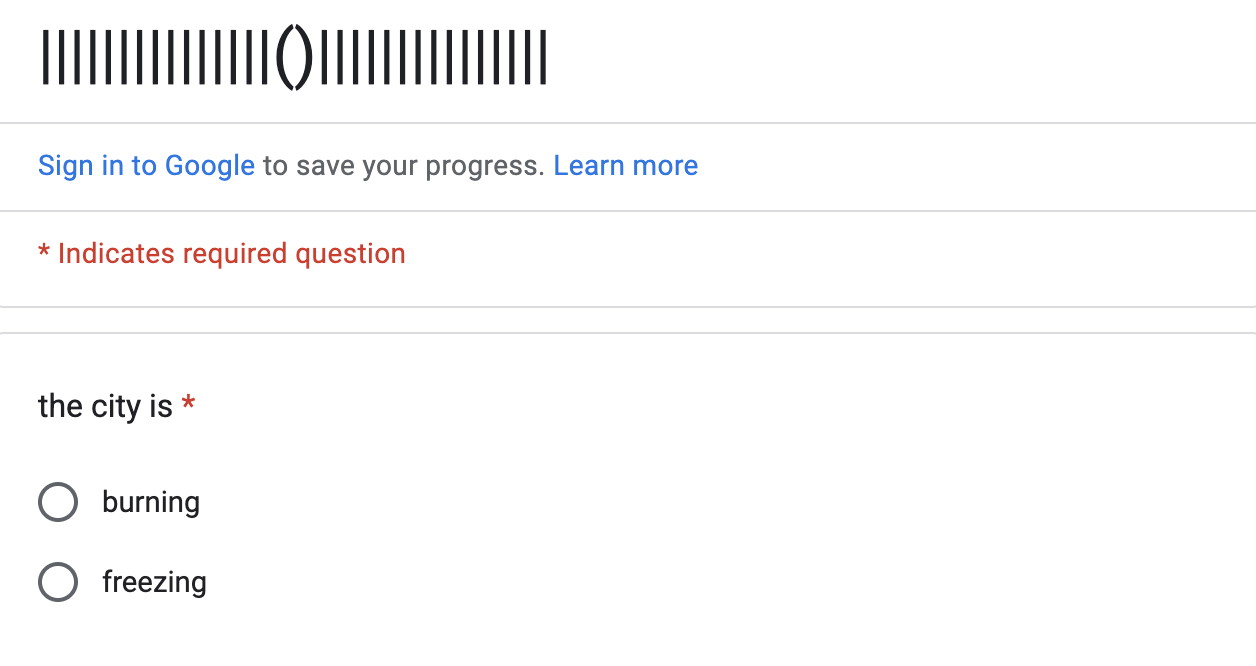
Tyler did a great job at illuminating how such a simple digital survey instrument (like the ubiquitous “google form”) can mirror the choices and micro navigations in everyday life. The piece unfolds as an interactive text in which readers click through choices that evoke the poetic disorientation amidst a fallen or doomed civilization. Rather than a traditional plot, the story is experienced as a series of associative leaps, where choices often feel less like control and more like surrender to the logic of the work’s emotional circuitry. Tyler scanned the room for your informal play-through strategies. Some of you went with what felt “right”, some chose randomly without any real conviction, some tried to build upon a loose logic of their own making. Is that how we ultimately live our lives? What Tyler made apparent was that many of these “moments of choice” were simply an illusion without much consequence. The city is always going to implode. The “choices” in the google form act as portals through shifting versions of the self, breaking with any cohesive or linear experience. In the end, we come to realize that the player’s “reading/writing” navigation mirrors the internal work of piecing together a scattered psyche. What is at stake here? Our sense of our own “cohesive self”? Free will or fate? Each click we make is both a decision and an act of reconstruction. We as readers are invited to make choices by clicking through links that seem to offer control over the direction of the story. But in the end these choices often loop back, collapse, or lead to outcomes that feel inevitable. All Our Time Tossed Selves pulls the curtain back on the illusion of agency in human life. This piece lets us know that fate is not a single, linear destiny but a looping network of multiple forms of self. Life is stringing along the many choices we make or fail to make, …each tossed through time and memory. It is a haunting piece, and Porpentine’s beautiful and wistful title, All Our Time Tossed Selves, is the key to understanding it.

Hannah Feels
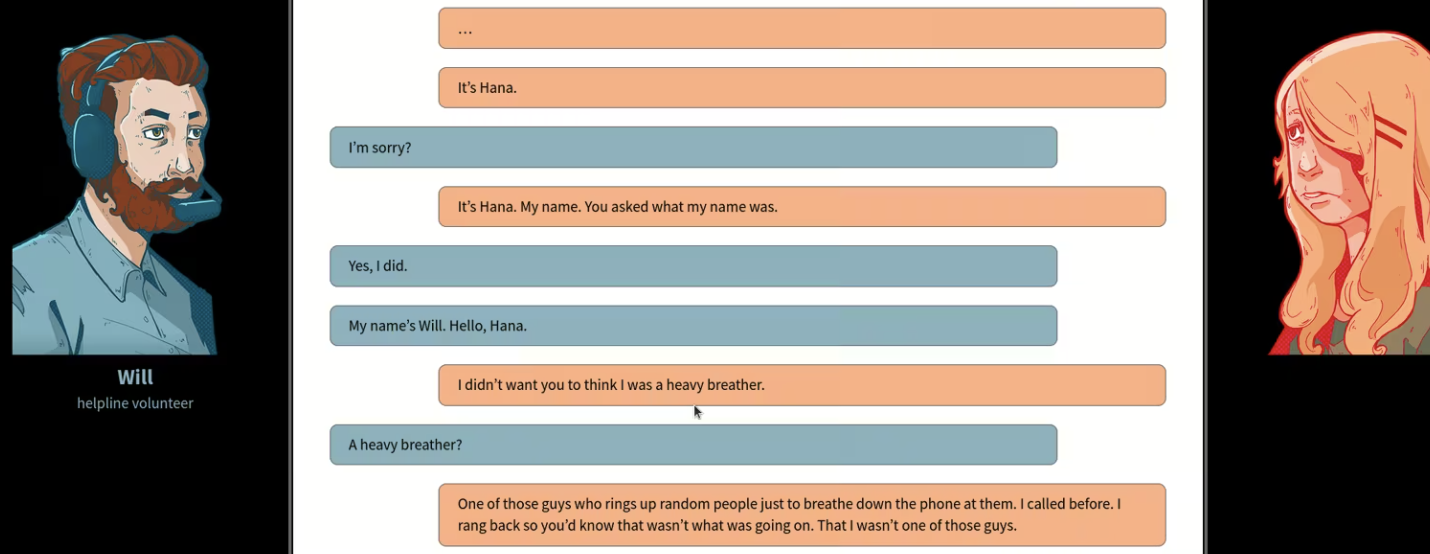
After a short break we turned to a another powerful piece of interactive fiction that uses player choice to probe the limits of empathy, agency, and control. Hannah Feels is about a young woman navigating anxiety, social discomfort, and self-doubt. By making decisions on her behalf, we as readers become complicit in shaping her emotional trajectory. To echo our discussion, we become responsible for her. We can attempt to “help” or “fix” her by navigating the interactions she has, but it soon becomes clear that these subtle interactions might backfire, emphasizing how difficult it is to impose external control on another person’s emotional reality. Thanks to Cindy for taking us through a potent and painful interface for storytelling. It was not easy to read this out loud in the room, but you did that work with all of us present and bearing witness to the acute pain of self-harm. We were confronted with the inner turmoil of self-violation by cutting. The more the reader-as-player tries to assert control, the more the story insists on the complexity and autonomy of Hannah’s inner life. In the end, our feeling of “responsibility” becomes a meditation on empathy. Hannah Feels seems to suggest that free will exists, but always within the constraints of context. That context may be mental, emotional, or even structural. We come to understand that freedom (for us as “readers” or for Hannah) is never absolute. It seems to me that both of our readings this week have reminded us that in digital narratives — as in life — choice is never as free as it seems.

For next week:

Please read Jenny’s selection: Retratos Vivos de Mama; and read Hunter’s selection: Writers Are Not Strangers.

Blog due: Blog about your reading experience and understanding of Retratos Vivos de Mama and Writers Are Not Strangers

See you in our our CAS classroom next week (11/10)!

Hana Feels & All Your Time-Tossed Selves

Electronic Literature puts a lot of emphasis on the medium in which you tell the story. Immediately upon clicking into All Your Time-Tossed Selves a jarring feeling creeps up on you. Utilizing Google Forms as a literary format makes the reader feel like they’re somewhere they shouldn’t be. In the backrooms of education, behind a barrier that students don’t cross.

The questions you’re being asked don’t feel like they are meant for you. It is unnerving having to pick an option based on little more than the sentence you are given. Things flesh-out as you move forward, but you never really get over that strange feeling that the creativity and the formatting don’t belong beside one another.

Hana Feels gave me a bad feeling in the pit of my stomach. The game brought me back to a time I try not to think about so much. Being forced to select dialogue options, not knowing how what you say will effect the person. The feeling that something terrible will happen if you don’t say the right thing. Wondering, if you had just said something different could you have saved the other person?

It does a good job of mimicking the vulnerability of trying to help someone in real life.

Choosing Paths

This week’s dive into E-Lit left me thinking a lot about control; how we use it, lose it, and sometimes share it with the text itself. Both “All Your Time-Tossed Selves” and “Hana Feels” play with this idea of user participation, but in completely different emotional registers. One feels like wandering through the ashes of a burning world, and the other like sitting beside someone in pain, trying not to say the wrong thing.

All Your Time-Tossed Selves

This piece felt like stepping into a digital poem that wanted me to choose its heartbeat. I loved the freedom of clicking through and seeing where my decisions would take me. It reminded me of a dream you can steer, but only slightly. The way it’s structured through a Google Form was surprisingly effective. Each choice opened a new fragment of poetry, but it also made me wish I could see the culmination of my responses to see the poem as a whole, Luckily, I screen-recorded my version.

The city is burning
The knights of the city have wings
How could they help but fly into the black wind?
The tips of their wings caught fire
“I feel you here in the orchard. In these trees of ash, bearing only embers.
Stop talking.
But you don’t eat anymore do you?
The apples tasted so good this year
As if they sensed the end was near
Did you taste them?
I did. In a sense. They were described in her letter.
My mouth watered, smearing the ink.
Did you write back?
I wrote back, but she never responded.
I see.
Let’s not get distracted.
I lost control in the last month of the year
And when I lost control…
…I couldn’t remember why I ever tried in the first place.
It’s fine.
Don’t blame yourself.
You couldn’t have changed the outcome,
even if you drowned me at birth, in the little stream running under the house.
So gather up your things as the city crumbles around you.
Try to stuff them into a much too small bag, only intended for the ten-minute walk of carrying your books to the tower…and now press-ganged into a walk of unknown and perhaps limitless duration…
What did you bring?
Useless knick-knacks.
The amber bird…I just need more time to make it sing again.
A hair-dagger.
Reams of notepaper, in hopes that one of them contains the seed of the formula.
I hope you realize the end of the city
is only a symptom of the end of everything.
It can’t be compartmentalized.
Running only makes it worse.
Did you notice yet?
How it keeps repeating?
Life isn’t done with you.
The flash tells you… no matter what decisions you make,
The time comes when everyone must.

“All Your Time-Tossed Selves”

It’s poetic and apocalyptic at the same time. Like the speaker is trying to hold onto something beautiful while everything collapses. What really struck me was the looping quality of it: “Did you notice yet? How it keeps repeating?” That moment made me realize that the poem isn’t just about a destroyed city, it’s about memory, futility, and maybe even the endless process of trying to rebuild ourselves. Each “choice” doesn’t change the outcome as much as it reveals how small we really are inside the system of the poem.

“Hana Feels”

If “All Your Time-Tossed Selves” felt abstract and poetic, “Hana Feels” felt painfully human. I was immediately drawn into Hana’s emotional world, and I found myself being so careful about every response I picked. I didn’t want to say the wrong thing or make her feel worse. I eventually got to the ending where Hana is about to open up to her mom, a moment that felt like real progress, like a quiet breath of relief.

The conversations with Jen, though, were another story. They stressed me out. Nothing I chose ever seemed to calm the situation or make Jen more understanding. Jen just came across as an awful friend, defensive, dismissive, and almost cruel at times. But maybe that’s the point: Hana Feels forces you to experience that frustration, to feel what it’s like to be trapped in a toxic friendship and still hope for something better.

As a teacher, I couldn’t help but think about this through my Social Emotional Learning (SEL) lens. The entire experience reminded me of the delicate nature of real-life conversations around mental health, how tone, timing, and empathy matter just as much as words. I found myself trying to be as kind and peaceful as possible, because I genuinely wanted Hana to feel seen and supported.

That’s what makes Hana Feels so powerful, it’s interactive empathy. Every click is a moral decision. The piece mirrors who we are and what we believe about care, responsibility, and communication. I realized I was trying to create a “perfect” conversation, a utopia where kindness fixes everything, but that’s not how real emotions work. Sometimes, even when we choose all the right words, people still hurt.

All Your Time-Tossed Selves and Hana’s Feels

All Your Time-Tossed Selves and Hana’s Feels

This week we had two super interesting works. I want to start with the standout Hana Feels by Gavin Inglis, Erin Rea and Stephen Redman. This work was emotionally captivating in many ways. I feel like the class discussion will be great and fruitful. I loved how this work was organized and presented to the reader. Seeing how different conversations effect future ones help build such a powerful narrative. The main thing that stood out to me was the authors’ notes. He believed that this work was more didactic than literary. After working through this, I fully understand this feeling. For me, this work reinforces the teaching that words cannot be chosen lightly. As the work continued and Hana’s problems and struggles became more apparent, the responses the reader chooses to hold much more weight to them. There were times where I had to sit and think long and hard about how I wanted to respond, regardless of what character I was inhabiting. Hana’s dynamic responses really breathe life into this work and contributes greatly to how the reader interacts with the story. Another interesting thing was the dynamic of power. With Will, Ernie and Christine, the responses were varied, and the reader is seemingly given a “right” and “wrong” way of answering questions. As readers, we have more context compared to the characters so, our answers are influenced by the previous vignette. On the other hand, during Jen’s sections I felt powerless, as her responses all seemed “wrong” given what the reader knows about Hana and the events that have happened. (Side note, if Jen has no haters, that means I have left this earth).

            The other work this week was All Your Time-Tossed Selves by Porpentine. This one was interesting since it pushed google forms platform to its narrative limits. This work uses all possible interactive elements that the platform provides the user with. The most interesting aspect of this work is seeing the stats about other people’s responses. I find this very cool because it adds a community aspect to this work compared to others. Seeing how others put together their respective narrative was actually cool to see. The only other thing worth mentioning here was that the responses were super well written and interesting. I love some good prose and this work had some great one liners. Crafting a story with the lines that were given was a great exercise of creativity.

All Your Time Tossed Selves & Hana Feels

All Your Time Tossed-Selves & Hana Feels

All Your Time-Tossed Selves

When I first opened All Your Time-Tossed Selves, I didn’t expect much from a Google Form. Within moments Porpentine transformed the familiar interface into something strange, poetic, and unexpectedly emotional. The structure itself: the radio buttons, drop-down lists, required fields, multiple choice questions, and linear flow became elements of the narrative. These components contributed to the story. I felt as though I was moving through a world where every decision mattered, yet nothing could truly change the outcome. That illusion of control perfectly echoed the piece’s theme of loss and inevitability, reminding me of a digital, choose your own adventure style poem.

What struck me most was the moment I realized I could see the responses of others who had played before me. At first, it felt like an invasion of privacy, as if I were glimpsing something I shouldn’t be. But soon it turned hauntingly beautiful, it was like uncovering traces of other travelers who had once wandered through the same ruins. Their words and choices added a new meaning onto my own experience. What I enjoy most about, All Your Time-Tossed Selves was how it reclaimed something ordinary and turned it into art. Porpentine used a Google Form to create something intimate and deeply human.

Hana Feels

This piece was so interesting, especially in the way it blended mental health awareness with digital storytelling. Hana Feels stood out to me because it invited empathy through interactivity, turning the reader into an active participant rather than a observer. Taking on different roles and speaking with Hana made the experience feel immediate and emotionally charged. Every response carried a weight that language has real power: to comfort, to harm, or to heal. The multiple endings added depth to that message, showing how the smallest shift in tone or understanding could completely change Hana’s outcome.

What I found most impactful was how Hana Feels used digital form to model real-world compassion. The interactive format created a sense of responsibility. It initiated reflection. This encourages readers to think about how they respond to vulnerability in their own lives. In this way, the piece becomes more than literature. It’s a meaningful exercise in empathy and awareness. It shows how electronic narratives can engage both the heart and the mind.

A World riting 2025-11-03 08:22:57

Create the storyline by inputting data into digital correct spaces

All Your Time-Tossed Selves is an interactive fiction created from a google platform created by author Porpentine in the year 2016. The story is a solitary storyline experience. You create the storyline by inputting data into digital correct spaces, and your being asked a serious of questions to create the storyline, it is created in Google Forms, and as your inputting the information in its proper spaces, you hit next at the bottom of the page to continue writing the story.  You control the narrative. Electronic literature is a powerful and fascinating way to tell interesting stories.

Hannah Feels is a game from the website that creates a controlled storyline. Like All Your Time. – Tossed Selves. A hypertext conversion created by Gavin Inglis in the year 2015. Input data information to create a storyline, within its digital spaces. To help with Hanna Feels mental health issue and build a conversation around the topic. Depending on your conversation will determine the outcome of the story. It is a wonderful game you need to try.

My Presentation and Hana Feels

Hey Everyone,

Here is a link to my paper and slide deck for All of Your Time Tossed Selves: https://docs.google.com/document/d/1iN8oAbIvAuFJcEk6Z5GG4Z9Rp3RjDxd7Ygep0IrR6C4/edit?usp=sharing & https://docs.google.com/presentation/d/1v5Its4UyiT885PBzTwHiLZQ08whdKCCUUvUhmoKEw1k/edit?usp=sharing

Let’s talk about Hana Feels!

What an interesting concept for this piece. Being a volunteer for a mental health hotline puts the reader in a position where a person’s life is in there hands. Right from the start, the stakes are high and I am carefully considering my choices because I want to make the “right choice”.

At the beginning, it says there are three different endings which really reinforces the weight of each choice.

As I am reading/playing this piece, I start to think it would be great for someone who doesn’t take mental health seriously or is not empathetic to play this/read this. The piece really makes you feel for Hana and it makes me want to help and understand her. I think this would be great for old school types who don’t take mental health and therapy seriously. It could be a good way to help change their views.

Another thought is that this could be a great training resource for people who volunteer for these types of hotlines. When I get to some of the choices, I really sit and think about what the best response is to say in each situation. It’s not easy to know which choice will lead to Hana opening up or shutting down and I’m guessing that is intentional.

It’s really cool that you get to play as Hana’s boss. It makes me feel uncomfortable that so many of the responses that you can pick for her are cold and mean, knowing what Hana is going through.

I really like how we switch to a new character after Hana’s boss. I guess this is how the piece will play out, with new characters being introduced. But I feel like it will come full circle and we will be Will at the mental health hotline again.

Wow! I mad it to the end! That was really intense and once Hana revealed her secret, I felt like I had to finish the piece.

To say every choice felt heavy would be such an understatement. Hana’s story is so relatable that I wanted to help her get the best ending possible. I think I got a good ending because Hana told Jen her secret and they stayed friends, Will was very helpful, and Hana called her mom and planned to meet soon.

All Your Time Tossed Selves/Hannah Feels

“All Your Time Tossed Selves” by Porpentine

Porpentine’s All Your Time Tossed Selves feels part interactive survey and also some kind of inward experience. The story opens with what looks like a questionnaire,  you’re prompted to make choices and respond to strange, poetic questions that seem to measure emotions, time, or maybe even parts of yourself.   All of this done on pull downs like you are answering a survey.  But it’s very unlike a real survey, you can’t just skip around or check boxes without reading carefully. Each question leads somewhere else, and the meaning only starts to unfold if you slow down and take in all the words. It’s like the piece demands your attention and your careful reading, it wants you to feel the rhythm of its sentences and the subtle unease of its tone.

Even  though it feels disjointed at first, everything begins to weave together the more you read. The repetition, the structure, the instructions, the sentances that you have to read even to pick the middle of the thought, these all  build a sense of being analyzed or maybe being lost in your own data, I liked that tension. And then, at the end, the graphs appear, I’m a marketing person by nature and I love a graph – its  colorful, almost like a reward (slightly competitive) or a summary of your emotional journey. They make you wonder if the piece has been keeping track of you all along.

This story is a mirror, reflecting how scattered and multifaceted our “selves” can be, especially in digital spaces. That we’re along for the ride and it may not even reflect our true selves. 

Experiencing “Hannah Feels” by Gavin Inglis

Exploring Hannah Feels by Gavin Inglis was an interesting but somewhat confusing experience. While the timing to this particular story was on point – my prior week was BAD. A reminder of mental health in our lives and how we make choices was a perfect place to land after this bad week.

The piece presents itself like an interactive story where your choices shape what happens to Hannah, the main character. It’s meant to pull you into her world and make you think carefully about how small decisions can affect someone’s emotions and wellbeing. However, I found it a little tricky to follow at times. Some of the prompts weren’t entirely clear, and it was hard to tell which choices would move the story forward or change the outcome in a meaningful way.