Conversation opened. 1 read message.

Skip to content
Using Gmail with screen readers

200 Pieces and Blackout Poetry

200 Pieces, Felt a bit like rummaging through a junk drawer. The work is scattered, fragmented, a little messy, I was a bit disappointed and frustrated because I really believed that I was getting the hang of this “electronic literature “. 200 pieces did not feel like literature.

One moment that really stuck with me happened about halfway through my wandering. I clicked into a small block of text that looked almost like a glitch It turned out to be just a few lines shoved off to the corner. It read like an unfinished memory: someone describing a bus ride, the way the window fogged up, and the blur of lights outside. It was only a few sentences, but I got the idea that we all have the small memories that may not tie into something else. It reminded me of those flashes of life you remember for no reason at all, scenes that don’t belong to any larger story, but stay with you anyway.

That’s what the whole experience felt like: bumping into moments that didn’t need to justify themselves. No plot arcs. No explanations. Just a collage of hints, confessions, images, and oddities. And the more I clicked, the more I realized the joy was in the wandering, not the understanding.

Tried out the Blackout Poetry Tool the other day, and wow, it turns out to be quite a trip. I grabbed a random piece of text and just started circling words that jumped out at me. There’s something so satisfying about turning a whole page into a little pocket of meaning.

I wasn’t able to get the ‘definition’ of what black out poetry is, but I was able to figure this one out quickly.  

At one point, I pulled this line: “Everything fades but the spark remains.” I didn’t even plan it, it just poppedup. I guess that’s the beauty of blackout poetry: the words are already there, you just have to notice them. At first nothing made any sense, but as I worked with the bot version, I started to see how you could create small patterns.  It’s kind of like finding your own secret message in someone else’s story.

You start seeing patterns, connections, little nuggets that you’d never notice just skimming a page. It felt more like a game.

There used to be these magnets for your fridge that were words and you could move them around and leave messages for your family or little poems or haiku’s, this reminded me of those magnets.  

It’s creative, a little meditative, and honestly not a bad and playful way to spend some time. But I’m not sure how it is literature, other than the poetry that might arise from the words.

Blackout Poetry Tool and 200 Castle

This week we covered two pretty cool works of E-lit. To start I want to talk about 200 Castle. This work again goes with the idea of accessibility within the context of E-lit. Augmented Reality works are really cool to experience in person. Much, if not all of their value is based on the interaction between the user and their device’s camera. Since I could only see this work through a video from author Caitlin Fisher, I feel like I am missing the point. It’s the same feeling of hearing a movie that people love to talk about and learning it’s hard to find online. From what I saw through the video, I can say that I am super interested in the work regardless. The work using a real book to flip through is a brilliant way of including a physical aspect into the work. The act of flipping through a book brings another level of immersion rather than scrolling on a webpage for example. The fact that the reader could read it out of order also added a level of control as the reader only interacted with images that they were interested in. The only issue I could consider having with this work is the fact that holding a phone or tablet while trying to see the book could be challenging, though I guess we will never know.

The other work that was covered this week was the Black Out Poetry Tool by Jazer Chand. I have to admit that I initially judged this work too harshly when I first looked at it. I am a poetry hater through and through (honestly, I just do not “get it”). Looking at this, I was kind of put off. The first setting of “Thesis” was pretty straight forward. I took my time to create a work from the first couple lines of Mary Shelley’s masterwork. The “anithesis” setting was off putting in a way. Since I took some time to pick my words, it was kind of a moment of whiplash to see the bot spit out a work almost instantly. It reminded me of my feelings of AI within the realm of writing (that’s a can of worms I do not want to even touch). It was with the “synthesis” setting was great. Working with the bot to create a work was way more enjoyable than I imagined. Rather than spitting out piece, the bot works with the user, vamping off of our selection. I liked how the bot chose words that would naturally fit with the words that the user chose. It creates the illusion of collaboration (only an illusion since the bot is not a real person, just a program). This new back and forth created a pretty interesting experience. Finally, the last setting worth talking about was “symbiosis”. While the user has total control of their word choice, the bot gives a number of suggestions to use. This felt like when word gives grammar suggestions on a paper. It ignores what the writer intends and only spits out what it “thinks” is right. Sometimes I ignored their selections, while other times it chose a word that fit into what wanted to do. This was another interesting option to use. This whole work seemingly looked to explore creatives use of tech. Some people create on their own, some use tech to think for them. But for many of use, tech is used as a tool to help our process. Creators negotiate with this dynamic today now more than ever. Super cool to see it play out through this work.  The visual option was nice if you are into that kind of thing.

A World riting 2025-11-17 09:25:48

Augmented Reality Literature: Caitlin Fisher’s Vision – Memory Castles and Enchantment Looking Glasses

Photo by Andrey Matveev on Pexels.com

200 Castles – Electronic Literature Collection Vol 4 Lareice Weeks-Bigelow.pptx

The Link: 200 Castles Untitled

The 200 Castles Book: Link Above

I’ve read that if you use your iPhone or tablet that you can see 3D images, and Virtual Reality images, as well as hidden stories within the photographs.

Blackout Poetry and 200 Castles

Hey Everyone.

Blackout Poetry Tool

This piece is really cool. I really like how there are different methods of selection.

My favorite method of navigation is synthesis where you select and the bot selects. What a fascinating way to work together with AI! This is a really unique way to be creative.

This tool seems like a great way to find inspiration by taking something that already exists and blacking out parts to create something new. I like how there are an infinite number of combinations of poems that the reader can make simply by selecting different words and phrases each time.

Using AI to help with the blackout poems feel like a great way to use AI to be creative while letting the reader work together with the AI rather than having the AI do all the work.

I love the simple interface of this piece and how the possibilities for new poems from the existing texts seems endless.

200 Castles

The concept of this piece is very interesting. It seems like the piece only fully works if you experience it in person. It seems like it’s a digital version of a museum tour guide / historian. On top of getting a story about each photograph, the video also showed how the pictures pop out on and change on the Ipad.

I have experienced augmented reality before with video games and it really is awesome. I think more places in society should have augmented reality components. Maybe this is a little dystopian, but how cool would it be to point your phone at different pieces in a museum and have them come to life and tell you a story?

I think this piece would have been really cool to experience in person and the effects would probably pretty mind blowing.

This piece does make think about the conversation around preserving electronic literature. Especially with a piece like this that was meant to be experienced in person to understand it’s full potential. What is the best way to capture and preserve a piece like this? And maybe a better question is, is it possible to preserve all forms of electronic literature or will some pieces be unable to be fully experienced in their original form as time goes on?

Blackout Poetry Tool & 200 Castles Reflection

Even though I did not have an iPad device to interact with the PDF Augmented Reality book, I found other ways to engage and experience with Caitlin Fishers augmented reality elit watching some of her videos as she shows the amazing changes and interacts with her own imaginative story out of her mind when the iPad is placed over each image related to 200 Castles content. Being able to decide in the confines of the framing device and image of each action taking place, movement over the images creates a story or release from some of the intense feelings put into each that will only be seen when the iPad is placed over them. Before that they are just images without a voice or story but come alive as we become the creators of their worlds and ours in the story. Interacting is an important factor with this elit work. The images would be stale, stagnant if not for the Augmented reality that comes from the iPad bringing the images to life and not needing any sound or text to create a story. Each reaction from the viewer will have a different affect to them
The theme and significance of each image towards 200 castles and its inhabitants continues as you proceed through the images.  Each has a life, relationship and purpose of their own but also as a whole to the entirety of the work. The audio and actual changes I was not exposed to as much as I would like due to the technological requirements needed.  This remains significant for meaning and interaction through a timeline of images. Some scenic landscape, Architecture and portraits all adding to the aspects that would make up a castle and human inhabitants.

Once again there is the theme of dichotomy that both elit works provided this week having a factor in our digital tech devices having its role only with our mindful interaction of use giving it a purpose while interacting with images bringing them new meaning as we act as human creators.  The contradiction would be using the iPad technology as a prescription lens to look into a past time and creating effects to each image that are recognizable task, trends to our own interaction with capabilities of the collaboration of our technology and digital media. They both though do have a dependency on each other device and flat image to make a new meaning, use and experience together. Then adding our own story to the text as a visual reading not written; to each image of what we depict the image relates to the story  and feelings that went with each.

The concept of a “binary” system of how we as humans interact with computers and technology when reading text was realized after reading the introduction and these terms amongst others of being an active participator related to interacting with the blackout poetry. There was a bond of trust, curiosity and vulnerability to the bot’s choices since it is common as humans we want the last say or sometimes dont like the results of a collaboration that reflects back to you almost like a group project. We go in front of our screens, which already causes these dichotomies of separation, or binary world. Especially when there is a goo reason to interact and have commands of using the interfaces, technologies and traditional ways of understanding our won interactions or when the computer/digital technology makes content or does certain task for us. The human element of thought, actions reflection, response all become in a way predictive of how we are supposed to read text, express and how we interpret these form others works and also share our own. I think the term “dichotomies ” adequately applies to this Elit work and expectations of what its intentions are in our lives. Sometimes the story and its content creation is not forseen or out of our hands.

Frankenstein text was a good choice with all the various words related to one of my favorite movies, and seeing how thought and action of selecting particular words to decipher, decode within the  Poems creation modes infused creating an attempt with my own selections and the bot’s choices to make sensible meaning. I was excited to interact with the text and make my choices down the page. My selections intermeshing with the bots started to make sense for a few lines, then it was just to much to think of how I could make selections that the bot would be able to build upon and make sense based on grammar, structure before knowing that the coding actually was already designed for this. After a few times I just let be and had fun with the interaction of me and the bot. So, I focused on my word selection choices and became curious to the bots afterward. The recurring piano sound did for me become too distracting. It would have  been pleasant to hear a variety of piano tunes playing as the mood changed depending on what words were selected and the type of lines formed. It was interesting to learn how the bot was selecting its poetry lines, based from my selections and the corresponding grammar sequence or  rule related to it in an attempt to form a line of poetry that seemed to make sense of the words selected, possibly wanting to make it so that I didn’t even realize the bot was contributing, interaction blurred between me and the bot with the more times I performed and the modes/ tasks of Thesis, Antithesis, Synthesis, Symbiosis, Visual. These seemed to be in an order where the code would best be suitable and produce the results needed bringing attention to dichotomies of man and machine interactions together and if we can make sense of each other’s choices.

Black out poetry tool

This one was so cool! First I would like to say that I thought it was really interesting that the website would offer us 3 excerpts from very popular novels. We had The Great Gatsby, The Time Machine, and Frankenstein or the Modern Prometheus! I also appreciated that for those who are not familiar with Black Out Poetry, there was a clickable option to get the definition. Now, lets move on to the work itself. I actually never thought about using an excerpt from a novel to create poetry you know? Let alone team up with a “bot” to create something. It was definitely a unique experience. The whole concept of this e-lit piece is innovative in the sense that it allows writers to discover new meanings through existing pieces of literature. I would also like to add that working along side the “bot” was quite comedic because I tried to “trust the vision” and it absolutely did disappoint haha. 

Example 1: You select; bot selects __

I think I was old instrument happy, unhappiness 

(Literally what does that mean) 

200 Castles

I’m going to be honest, this one overwhelmed a little bit because I wasn’t sure what was going on. It’s probably a me issue because I suck at analyzing things and finding a bigger picture. However, what I did pick up is that this piece is like virtual reality with an iPad? I scrolled down to watch the short documentation.. but I’m confused.. what was she reading? I guess my question is where is she getting the readings from? Unless its on the iPad and thats essentially what it is? But it also did get me thinking about VR and what a cool experience it would be to read a story with a virtual reality. But not an iPad, more with the VR headsets possibly. I think the concept of VR stories would be absolutely the coolest thing ever but also expensive. Imagine reading Rebecca by Daphne du Maurier in real time and experiencing Maxim kill his wife but you’re witnessing it! Or better yet, some kind of Edgar Allan Poe story in real time woooahh!!!

Blackout Poetry & 200 Castles

Blackout Poetry Tool: I am no stranger to blackout poetry but it does make me feel a little overwhelmed sometimes because it feels permanent to blackout someone else’s words to make my own piece. I think this is an amazing tool for people who are maybe intimidated by blackout poetry or are unsure of how it works. I’ll attach a screenshot of the first poem I created. I had a lot of fun with this piece and I liked that you can choose different ways of producing the blackout poems such as you picking or a bot or both. It actually reminded me of Maya’s thesis project a little bit.

The synthesis option where you select and the bot selects was actually very frustrating. It was not catching my vibe and the direction I wanted my poem to go! It seemed to choose prepositions mostly and made nonsensical choices for its selection. Moral of the story, AI cannot replicate your voice/thoughts and creativity!

200 Castles: It took me a minute to kind of understand what was going on in 200 Castles. It was a different experience than what we’ve seen so far. It gave me more of a clinical feeling or just overall disconnection and less immersive. The video also didn’t give me much. I would have loved a full walk-through of the storytelling even if it is “non-linear”. I haven’t experienced a lot of augmented reality or even virtual reality so it was definitely interesting to read about and kind of experience. One of the videos is removed for privacy reasons so the one video almost just felt like a trailer of 200 castles (unless I’m missing something). Overall, I was underwhelmed but maybe I’m missing something so I look forward to the presentation on Monday.

Blackout Poetry Tool & 200 Castles


Blackout Poetry Tool

Okay, so what’s cool about this is that in the beginning of the semester, when we had to browse the volumes and choose a piece to discuss with the class, I actually played around with this one for awhile. Of course, it’s been about two months, so I do not remember all of the intricacies of this piece, though I do remember a feeling of annoyance. Though, I think that it is only natural to feel that way when working on a blackout piece, or a cento, or any sort of form that forces the writer to deal with only a certain group of words. But, when you finally make it work, and what you are left with, or what you pasted together, all makes sense, it is quite rewarding.

Here, you will find what I created as my thesis. I liked it for the most part. It’s weird when you make something from something you otherwise would not have made. What I mean is, I’m not sure I would ever come close to recreating such a piece with these words, this spacing, this tone. It really is quite an odd feeling.

Now, onto the annoyance. The bot created a very short poem which exudes a certain elegance I can’t quite place. I am unsure if this “elegance” is really just dissonance, but I appreciate it nonetheless. Don’t get me wrong, I am entirely against any sort of AI creating poetry. But, this is also weird. It oddly makes me wish I made this version instead. I don’t know what that’s about, because I am a successful poet. I’m not really sure what to make of it.

Yes, more annoyance. Co-creating with the AI was annoying. One, because I don’t know this AI. Two, because it picked its selections awfully fast. How can one just pick by means of an algorithm, rather than true consideration. It was quite off-putting. Plus, it picked weird stuff that didn’t take into account the rest of the words left. For example, it kept picking the preposition “in”, which was very hard to connect with other words as we went further down the given text. Relinquishing the control in this way, in the name of coherence, was difficult because what is a poem if you cannot understand it enough to feel something upon reading it?

My symbiosis was whatever. I’m not putting it here because I actually ignored the AI. At this point, I thought, “who cares what it wants me to do, especially when it picks nonsense?” So yes, I think the AI points me in the direction of nonsense, for some reason. I think it has it out for me.

Yes, it is just making nonsense. Here, I would like to discuss aesthetics. As many of you may know, I am quite versed in concrete poetry. With that, I deeply understand the purpose behind making shapes with my words to convey meaning. What annoyed me in the last section was the idea of the wave, which most likely will amount to no sense in the name of shapes. All I have to say is, if you want the words to represent something other than the meaning of the word itself, there must be more consideration of such symbolism.


200 Castles

After looking at the documentation video provided on the website, I can see the augmented reality really come to life. I have zero prior experience with AR, so it was cool to see what exactly is being augmented. Seeing the pages transform with a new texture layers on different meaning and experience. What I really enjoy about this piece, too, is that you have both versions in front of you. So, one cannot work without the other. Instead of translating a physical piece into an electronic state, which may lose, like working with two languages, the essence of the original, the reader can navigate both simultaneously. Overall, this seems to be a really awesome piece that blends together the analog with the technological in a way that complements both mediums.

Questioning Authorship

I am glad we started class with some opening reflections on what is possible regarding your final projects for Electronic Literature class. I hope your freewriting time and the open discussion with peers helped open up some early ideas about what you would like to make in the final stretch of Elit Class together.

Death of the Author?

In his 1967 essay “The Death of the Author,” Roland Barthes argues that the meaning of a text does not reside in authorial intention (what the author intended to say). Rather, the meaning of a text emerges from and through the reader’s engagement. In other words, the interpretation of literature belongs to the reader rather than the author. Meaning is not given by the author but it is produced by the reader. After our discussion on Monday, I started to think about the pairing of these two elit pieces with this Barthesian idea of the “readerly” versus the “writerly” text, and his well known claim that “the birth of the reader must be at the cost of the death of the author.”

Thanks to both Jenny and Hunter for their thoughtful presentations on both of these elit readings. On face value, the two works are seemingly disparate. But ultimately, they both have things to say about the dynamics of authorship and readership.

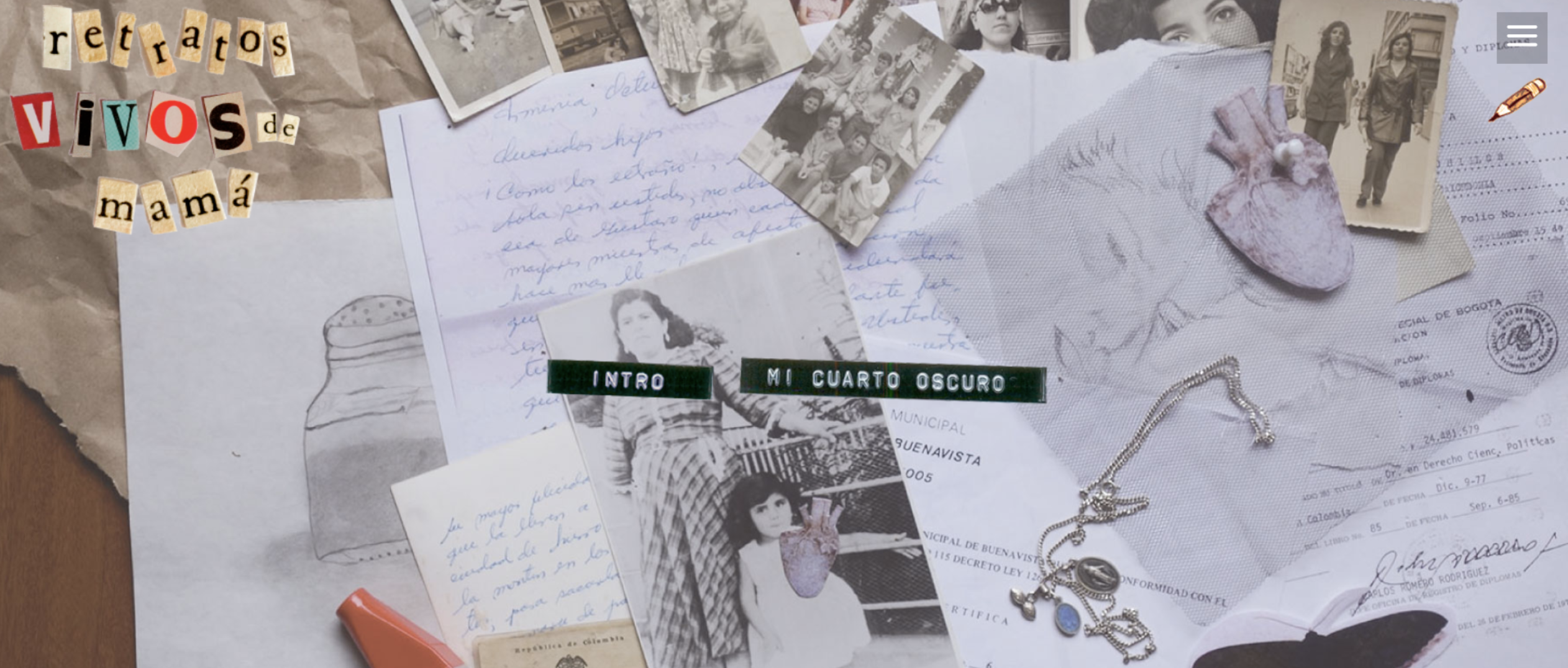
Retratos vivos de mamá

Retratos vivos de mamá by is a beautiful scrapbook and collage of personal bereavement, grief, and the intimate experience of mourning. It is a “living book” that continues to expand in time with new components to the work added as the author moves through the very personal and potent experience of grief. Photos, sketches, videos and recorded sound are layered with her own text. These sensory traces of a life stand in for Mama. Multi-modal forms of media become proxy for the body and voice that are no longer there. The layering produces a feeling of a living portrait made out of remaining objects and artifacts that her unique human life has left behind. As Jenny made evident in her walkthrough, grief is both a private experience, but here, it is simultaneously offered up publicly as a cultural object. With Retratos vivos de mamá, we are asked to believe that digital media can preserve the presence of the dead. As the multimodal artifacts let absence feel “present” in the reader’s experience, what is at stake in re-creating that presence? And on whose terms?

Writers Are Not Strangers

On the other hand, we read Writers Are Not Strangers. This is an interactive fiction in which the reader or player is asked to rate fiction fragments. In this way, the reader enters into a meta-critical “loop” about writing, judgement and audience. The protagonist Alix is a YouTuber and writer whose mother is dying. The reader rates Alix’s work and becomes a key engine in how Alix’s story plays out. The story itself blends text and interface elements like rating stars, scores, and “reader as judge” mechanics. This flips the usual power dynamic. In a traditional framework, a writer presents (and a reader consumes). But here, a reader judges (and a writer reacts). Writers Are Not Strangers connects the mechanics of judgment (you, the reader, assign scores) with the emotional consequences for the character. The fact that you-the-reader rate the fragments isn’t just a novelty. This is the message. The interface enacts a problem: writers are subject to metrics, readers enact judgment. And of course, this raises ethical questions. As readers, what responsibilities do we have?

Authorship and death in the digital age?

Both Retratos vivos de mamá and Writers Are Not Strangers examine how digital media mediate human connection, whether through memory of the dead or in relationship to the artist in a consumer-driven world. Both show how electronic literature turns interaction itself into an act of meaning-making. In Retratos vivos de mamá the “author” of meaning is not the biographical mother or daughter but the reader, who reconstructs significance from fragments. In Writers Are Not Strangers the relationship between author, reader, and meaning is dominated by ratings, metrics, and feedback loops. In the end, both readings this week make us look closely at authorship in digital contexts: one through memory and mourning, the other through metrics and mediation. Roland Barthes declared that the author must die for the reader to be born. And this week in elit class, we catch a glimpse of the fantasy of death never being final. In Retratos vivos de mamá, the author returns as an affective ghost, and in Writers Are Not Strangers, Alix survives only through the algorithmic engagement of her readers.

For next week:

Please read Nas’ selection of Blackout Poetry Tool  and Lareice’s selection of 200 Castles. Please write your next blog about your reading experience and understanding of Blackout Poetry Tool & 200 Castles.

See you in our our CAS classroom next week (11/17)!