Yardley, PA & Avenue S

Yardley, PA & Avenue S

Both Yardley, PA, and Avenue S are an exploration of space, but neither in a typical sense. Yardley decorates the screen with poetry. Even selecting the same key over and over again leaves you with the line patterned across the screen.

‘A’,’A’,’A’,’A’,’A’,’A’,’A’,’A’,’A’,’A’,’A’,’A’,’A’,’A’,

“Russell used to beat on me and my brother“.

In my version of the poem, this is the first line. But the beauty of Yardley, PA, is that you can “play” the poem many ways and choose many first lines.

“Play” has multiple meanings in this context: like a game and like an instrument.

Every key on your keyboard becomes a line in a poem and a musical note played aloud.

Avenue S is an exploration of space through clicking across screens; it is meant to overwhelm you and make you feel lost. There are click-through images, pop-ups, and things that might confuse people unfamiliar with certain digital proprieties concerning navigation.

Both of these projects explore space and navigation, yet through entirely different lenses. While Avenue S is more direct via classic click-and-explore navigation, Yardley allows you to write a poem and play an instrument at the same time, creating an intricate lace between physical space (screen space), sound, and poetry.

Yardley PA 1997 and Avenue S

  • Yardley, PA, 1997
    • I really like how in order to make the text move, you can press the keys in a certain order or just press the spacebar.
      • Pressing the keys in a certain order makes this feel like a game which is really cool. 
      • Great choice by the author to make this decision as it really leans into the game aspect of interactive fiction.
    • The background colors, font, and fireflies invoke a short of coziness. It gives vibe of Summer evenings catching fireflies.
      • Since the piece has the year 1997 in it’s title, I am assuming it takes place then.
      • I definitely get nostalgia vibes from just staring at the piece.
    • The music sounds like it could be a vinyl record because I can hear record scratches.
      • It is very calming and really adds a wonderful dimension to this piece.
    • The way that the words fade away like fireflies in the dark is really working for the piece.
      • I like how the instructions tell you to press the button to make the next line of text appears as soon as the last line disappears.
        • This plays into the firefly motif since they glow and then go dark as another firefly lights up.
    • What a hauntingly beautiful ending. The way all the text overwhelmed the screen and the music rises to a crescendo and then it all flickers away into the darkness as we are reminded how ephemeral everything in life is.
  • Avenue S
    • What an interesting piece! At first I thought it would be more text based and straight forward, but there is a lot of imagery here that needs to be interpreted.
    • I think I understand one aspect of how on some pages there is a ton of clutter which is the idea of living in a city that the author misses.
    • It’s interesting how some things on the pages, like certain images, take time to make their full picture. This can be a metaphor for having to wait for things in the city – like buses, trains, lines, or slow walkers.
    • I think the author is showing what city life can look like to outsiders – overwhelming and crowded. But to people who live in the city, it is the hustle and bustle that makes the city feel alive.
    • It’s interesting to note how simple all of the people are drawn. Maybe this is the author’s way of saying that in the end, all people are the same, no matter how you appear on the outside. 
    • I really like the aspect that the reader has to make meaning out of this. The author gives hints in that each page has a different title if you look in the name of the tab. It seems the story being told isn’t a solid narrative, rather it is a series of the author’s observations about city living that tell a story of change caused by Covid.
      • What happens to the crowded city that you love, when it’s people are forced to stay away from each other? If you came to the city for the connection, what do you have in the Covid era? Just isolation. For those who feel alone, Covid in the city is an awful reminder that no matter where you go, the world is forcing you and others to keep your distance (physically and emotionally).

Yardley, PA 1997 & Avenue S

Yardley, PA 1997: I thoroughly enjoyed this piece. I loved that it was a multi-sensory activity. Initially I just clicked through but I did notice sound-wise something sounded off so once I read the little description about the “score” and all that, it made a lot more sense. I really loved the actual poem itself but I also loved that it was also interactive in performance of the piece. It was more simple and effective as far as electronic literature goes. It was straightforward as far as what to expect going into this piece. Before this piece, the other pieces we walked through so far have had hidden like “easter eggs” somewhere within the piece and having many ways of navigation. The different approach to navigation of previous pieces could be fun but it is also overwhelming at times. Being in class and realizing I missed a whole section because I didn’t click the small illustration in the top left that unlocked the entire meaning of the piece could feel discouraging. I think this is a good entryway into the world of electronic literature. Yardley, PA 1997 had a very nostalgic feel and a layer of melancholy.

Avenue S: This piece executed the chaotic and uneasy feeling of the COVID-19 pandemic. I don’t think we acknowledge as a society how traumatic that time was like the world really shut down. We witnessed people dying, the feed of misinformation, fear mongering, divide, isolation, and so much more through our screens and in our lives. We simply could not escape anything (and still really can’t). We cannot move through the world without acknowledging that the world is different post-pandemic. I was definitely feeling overwhelmed with so many different things to click on but my favorite piece that I got to was the collage titled “THE GREAT EMPTY”. It gave a very disjointed feeling but still conveyed exactly what was happening during that time. We lost many things at that time but I think one of the hardest things we are struggling with to bring back is a sense of community and socialization. I thought the artwork was very effective as well as the pieces of poetry that were embedded through the piece for example the haiku called “Covid haiku” by Sally Stein on the section titled “mask culture”. Overall, this piece made me feel very overwhelmed.

Artwork related to Avenue S

Hello, I wanted to share some 2D artwork that I created in 2019 when I was taking a course for digital media multi-media design. This was about 2 weeks after going fully remote when I was in MCCC. We had to do a project about how we felt, about isolation and the effects that the pandemic was having on us personally as well as globally. After seeing some the the artworks in Ghost City in Avenue S I thought the theme of my drawings were similar. These representing object that are isolated, but start to make their way outward and over come the barriers and effects from loneliness. Thanks.

Avenue S Reflection / Yardley, PA 1997 Presentation Links

Avenue S

Once entering the piece and I first notice the rectangle shapes that automatically depict what many were going through globally during the pandemic having your surroundings boxed in, separated, isolated. The dates on the front of each replicated for me the idea of a Time Capsule, or a day in one’s life that was significant. Whatever content would be inside is going to be meaningful to someone if not me, or create a sense of belonging, interaction that many of us were deprived of. Also, a morbid image was present also that of a mausoleum for remembrance with all the rectangles and having dates on them. Like a piece of each person who had died in some way but was left behind for remembrance when you click on the title. There is sometimes filled with memories, items of the pandemic that we all become familiar with such as nylon gloves. There were so many interesting pieces in Ghost City Avenue S.  I think we were all more at play, willing to dive deep into our imaginations for mental health reasons, something that we were not allowing ourselves to do when things were “normal” and our lives being filled with all the social and professional distractions of everyday living. The opportunity to express ourselves and still have some kind of voice, interaction with life had opened up in so nonconventional ways and the resources around us were used as extension of those surroundings, people or lack of as well to also resist what was happening or have a coping mechanism outside our uncertain worried thoughts by creating. Being reminded and having an archive of all the social aspects we took and still take for granted, and freedoms such as lingering effects when everything seemed to lack life, meaning, interactions, color.

In some of the pieces the movable elements started as a small, isolated piece, boundaries set with their lines which then overflow or expand outwards similar to what happened as things started to open back up in society. We took small steps, still distancing ourselves due to our own comfort levels and willingness to trust again ourselves, others, and powers to be. The shapes filled up at times in a type of unilateral patterns, or in conjunction with each other simultaneously. Then at points there was disbursement of movement  from the inner core to the outer like one reaching out and expanding their presence into one’s surroundings.

The one release and escape during that time was creating art and taking advantage of our resources. Our identities and how they changed were put in flux with the things we no longer had around us, interactions to validate who we are. I think a lot of the Ghost City clips were strongly about one’s identity, fantasy and playing role away from the current world that was being offered with uncertainties, fears, loneliness. Many of the artwork’s movements were morphs or mirrors of each other. Isolated and Alone depicting urban life and the changes brought to social interaction and energy that was once prominent in the streets and neighborhoods amongst each other.

Yardley, Pa 1997

Yardley PA, 1997 Powerpoint Link and Word Doc Reflection Analysis

https://1drv.ms/p/c/cf24af06c39ff09a/EfXrSvq-mi9JrQU5GJWDNIYBhLm3uwHFKglV4QeMqrz8UQ?e=O9jnaZ

Yardley, PA 1997 JNorton Reflection Analysis.docx

https://1drv.ms/p/c/cf24af06c39ff09a/EfXrSvq-mi9JrQU5GJWDNIYBhLm3uwHFKglV4QeMqrz8UQ?e=O9jnaZ

Yardley/Avenue s

Yardley, PA 1997

Todd Anderson, the author of Hot Writing created a collection of 17 digital poems aka interactive poetry. Yardley, PA 1997 being one of them introduced us to a whole new type of poetry I didn’t know existed. I thought this was a very interesting take on keeping those who don’t really enjoy poetry to be entertained. Not me, I love poetry. But I can definitely see someone playing around with this and making multiple different poems. I deeply appreciated the fact as readers who get a say on how we’d like this poem designed as well as how we’d like this poem to sound. I played around with this poem quite a bit.. I would literally press each key multiple times just to see what would happen but that in itself was a bit poetic. I was like “ Secret! Secret! Secret! Secret! Secret! Secret! Secret! Secret! Secret! Secret! Secret! Secret!” a whole bunch. I have noticed that with the few e-lit pieces we have completed, they all have a different experiences in terms of how I feel. Throughout this piece, I felt a sense of nostalgia.. like when as kids we’d have xylophones in school or little fun entrustments to keep us distracted at doctors offices. I also tried  playing multiple keys at once, and the tension definitely arose. It was a bit chaotic, as if I had to read the lines really fast so it doesn’t disappear. 

I did find this reddit post where a user named “Toddwords” was answering a few questions about their work with Hot Writing and Yardley PA 1997 gets brought up through the thread. Im obviously not too sure if this is the real Todd Anderson answering these questions but I thought it was kind of interesting. (https://www.reddit.com/r/books/comments/5xbwwh/i_am_todd_anderson_creator_of_hotwriting_the/) 

Avenue S 

So for this one, I decided to review the piece “By date” because when I initially started, I will definitely say I was getting a little overwhelmed with all the clicking and where it was taking me. However, clicking through by date was a lot more fun for me because COVID for me feels like it was yesterday. Each date that was provided was a date I vividly remember 5 years ago. I was an essential worker during that time working right by Elmhurst Hospital in Queens, NYC during the time. That hospital was practically ground zero of Nyc due to the high number of cases of covid plus deaths. They literally had body bags outside because there was no room inside. I had to go into work everyday, and if you know anything about the city of Elmhurst, its never quiet. But during covid, it was a ghost town. So the fact I got to choose the date made this a lot more relatable. But again, thats what this e-lit piece is meant to do. The experience depends entirely on your own interaction of it. Honestly, I feel that if this piece included words, it wouldn’t work. The pictures of the desolate city, graffiti, and drawings all create an experience. A haunting experience.

I will say that this piece is about being isolated during this time of covid but going through this piece did not make me feel alone. I felt a sense of connection because its as if we were living this horror at the same time? The dates were like a journal entry and we were living it together. For example, on May 19, 2020..it was my 21st birthday and I didn’t really do anything because covid was at its peak and that date in the poem portrayed the same experience. Masks and social distancing. Lastly, it seems that this poem will not have an ending…because covid is perpetually open in our lives. I still talk about that time as if it was yesterday and my future will be shaped by everything that we went through in 2020. 

Yardley, PA 1997 & Avenue S


Yardley, PA 1997

I would like to begin this section of my blog to say that I really enjoyed this one. The first time around, I went the linear way. Going across the keyboard from left to right and shifting the keys as the instructions advised. Usually, when looking at electronic literature for this class, I do not read the instructions and just go. For this, I do not know why. I think I just like to go into it and try to figure it out on my own as well as find what speaks to me personally. Though, I do read the statements by the author and the summaries of each piece. So, when I saw that it involved the keyboard, I knew I had to buckle up.

I expected something a bit more radical than what it actually was. I think I was more so expecting some kind of crazy technique requirement that I could not keep up with. Though, I was pleasantly surprised when all I had to do was make my way down the keyboard and press new keys once the words and music began to fade away. I thought the delivery of the poem was quite beautiful, and really mimics the way we read poetry on paper. Although there is no fade away of the words or built-in music to accompany our reading, the way in which both of those aspects carry the piece is a great way to creatively imagine what goes on in our heads when we read poetry. Things oftentimes click in our heads from line to line, creating a personal symphony. Yardley, PA 1997 helps us do this in a way that is more connected to another’s experience. Unlike the other pieces of ELIT we have read so far, this one stands out because you can go through it the same way another person does, or not. The choice is yours, and I really enjoy that idea.

Lastly, I would like to discuss the content a bit. I think the way in which the author brings about the various aspects of 1997 in Pennsylvania and the specific instances in which they live through was really beautiful because it made room for readers to connect in their own way. Specifically, the short section of about the brother, and how the author reflects that they should have told him they loved him more. I really liked how there were times in which we knew we were not in Yardley, PA, but instead taken back into our own lives, wherever that may be, and given a chance to reflect.

Overall, this was a really great piece, and I think I will find myself returning back to it. I enjoyed its simplicity and the fact that it had no “tricks” or hidden meanings — it was all laid out for us to type through and reflect on.


Avenue S

Reading first, of course, what Avenue S is about, I was immediately pulled in. There are plenty of COVID-19 experiences written and heavily discussed today, but I knew that this rumination would be an outstanding one. First, just stating right off the bat that the speaker missed urban life is a statement that everyone though in some way or another, but to just be laid out in such a way that is pointed and speaking for itself was a great way to start. The world at large missed so many things for a great amount of time that just admitting we missed a part of our lives demonstrates a vulnerability that is pertinent to literature tackling such matters.

Clicking through the dots and mandalas, the first page that really connected with me was “bouncing off the walls” . The way in which the simplistic art renders itself is really fantastic. The constant movement of the stick figures demonstrated quite well the shell of people experiencing the pandemic, and how we were limited to just a specific space — in this case, the screen. Additionally, the lack of color in this section goes to show how staying in one place, forcefully, can remove the color we have in our lives because we are not out experiencing what we otherwise would have. Once clicking on the three dots, I was brought to “butterflies in the stomach”. Again, we are met with a simplistic stick figure who seems to fade into themselves, generating a gear, or a butterfly, preparing to take off. I find this an interesting way to symbolize the anxiety felt during these unprecedented times, especially because this gear-looking image is composed of smaller human-like figures. Not only can this symbolize the many facets of one’s own personality ruminating in a way that works against one’s own person, but how the expectations and well-being of others was also a great source of worry for people during this time.

Lastly, I wanted to discuss “endless cycle”. I think this page put into perspective the idea that life-altering events will always happen, whether on a scale as massive as COVID-19, or on a personal scale. Though this may seem to be a bleak perspective, I choose to see this animation as somewhat hopeful, as the stick figure, after falling and sliding, continuously gets back up. Yes, the figure does fall again after getting back up, but it’s the action of rising again that intrigues me, and makes me hope that in moments of failure or sorrow, I am able to get back up again, even if its just to go through the same sort of perilous time again and again.

Overall, I quite enjoyed the flashback to 2020-21 that this piece brought. I found myself more drawn to the simplistic features of this piece because it allowed for more connection. Using a simple stick figure really works well here because anyone can input themselves and their own experiences into this work. It is also really interesting to. be interacting with this piece now, as COVID-19 has been behind us for a few years now. In day-to-day life today, it’s easy to just go on and not think about what happened to us not so long ago, but it was a major life event for all of us. Though, moving through this work, it was really interesting to be brought back to that time (I was a junior in high school!) and reflect on it today. How easily we forget.

A wonderful launch of our “Elit Class Presentation Series”

What a way to begin…

Despite the fact that we were grounded in Zoom class due to the windstorm last night, we still were able to have a truly fascinating and meaningful conversation thanks to Maya & Sarah and their selection of two great “headliner” pieces of elit. Maya’s selection (Welcome Home) is not found in the most recent ELC volume, but it truly fits into a broad understanding of what is considered electronic literature these days. Sarah’s selection of Façade is a known “cult classic” and has been upheld as a foundation to the field for sometime. Covering these two pieces last night was the perfect way to open our “tour” together. Both Welcome Home and Façade and can indeed be considered meaningful works of electronic literature. Each piece uses digital media to rethink how stories can be told, but they do so through opposite strategies of engagement.

Welcome Home

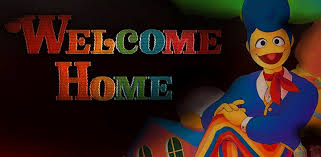
Despite first impressions, Welcome Home is a horror–tinged web-project built as an alternate reality game (ARG) as well as a “lost media” restoration site. This piece serves both as the “archive” or “restoration” project, at the same time that is an interface through which players explore hidden content: secret pages, hidden text, image & audio artifacts, guestbook entries, puzzles. It has dimensions to discover – it is not just an experience of reading content, but an experience of exploring, clicking, discovering, and peeling back hidden yet intentional layers. This expands our understanding of the act of reading, no? One of the things that is fascinating here is that it is not simply confined to the piece itself – the Welcome Home website. Instead, fans analyze, share, document hidden clues; the community includes people decoding codes, sharing theories. The mysteries (hidden text, puzzles) are designed for community involvement. This is important to how this artist designs, and more broadly, how meaning is co-created in the age of participatory media-making. Maya did a fantastic job at sharing how this website is a unique and complex narrative world. She showed us a glimpse of the many hidden messages that are disturbing or ambiguous. Welcome Home is not just a site, but also a portal where the story “lives on” and haunts us. Readers are situated as a “neighbor,” invited into this world, and invited to witness. Ultimately, the reader/player can’t always know what is fiction vs what is “in-universe.” There is a dark shadow to the blurring of these boundaries. And yet, this shadow ambiguity is part of the overall seduction and appeal. Somehow all this emphasizes the responsibility and work involved in being a close reader (of any world).

Façade

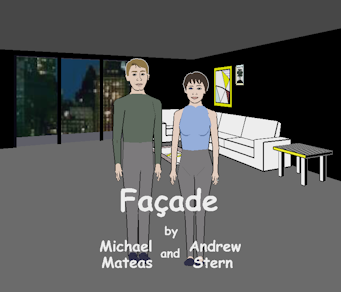
Façade unfolds through direct real-time interaction. The reader/player finds themselves inside an intimate drama where every typed word can alter emotional dynamics between Trip and Grace. This piece is rooted in the dream of “procedural authorship”—that is that natural language processes could enable a story to respond fluidly, as if alive. The narrative emerges moment-to-moment, co-authored by human and machine, emphasizing immediacy, presence, and dialogue. Sarah did a wonderful job at breaking down the actual game mechanic, presenting a flow chart of possible choices and ultimately knowing the six possible endings that are coded into the interface. Façade is often called the first true “interactive drama” — blending the aesthetics of theatre, film, and literature with game interactivity. Façade has become a landmark in AI-based storytelling research, because it’s procedural approach anticipated later developments in emergent narrative, machine learning for dialogue, and interactive performance systems. I love how Sarah knew this piece in-and-out, and her self-confessed love-hate relationship with it makes so much sense to me. Perhaps this love-hate feeling for it added to her ability to open it up for us so thoroughly. Despite the fact that all of you did not have access to the game play, last night during our collective “walkthrough” you might have felt that feeling of what good e-lit aspires to be – a living, responsive performance shared between human and computer. 👏☺️👍

How we can learn from these elit pieces (in connection)…

Both of these selections (bravo Maya & Sarah👏👏) share a deep interest in the relationship between reader/navigator/player and a storyworld.

Each asks what it means to enter a narrative space and be implicated in it (like a “guest”)—whether as a participant trying to mend a marriage (Façade) or as a “neighbor” uncovering a lost show (Welcome Home). They both blur boundaries between author, audience, and medium, inviting readers to perform narrative through interaction rather than consume it passively.

Façade’s procedural immediacy versus Welcome Home’s fragmented nostalgia—marks an evolution in digital storytelling. From the fantasy of seamless conversation with digital characters, to the fascination with the broken, haunted textures of media itself: Façade dreams of living stories; while Welcome Home dreams of stories that refuse to die.

Your to-do list

Please read the following selections by Jason & Jen:

Blog due: Blog about your reading experience and understanding of Yardley, PA & Avenue S 

Exploring Façade and Welcome Home

I wasn’t actually able to get Façade to run (apparently that’s pretty common—it’s an older work that doesn’t always work with newer systems), but I read quite a bit about it. It’s described as an “interactive drama” where you, the player, show up at the apartment of a married couple, Trip and Grace, who are in the middle of a fight. You can type your own dialogue and the characters respond, sometimes in unpredictable ways.

Even just reading about it, I could tell how unique it must have been when it came out. I loved it and was a little bummed that I wasn’t able to play with it.  The idea that a computer could listen to you and react emotionally feels kind odd and yet compelling. What I found most interesting is how it explores communication and miscommunication. You step into someone else’s relationship and try to help (or maybe make things worse). Being an actual communication major this really interested me.  I did check on-line and notice that everyone else was able to get into Façade, I was a bit jealous, but my technology was just not compatible.  I was really sorry that I had not bought a Mac Book earlier on my graduate school experience (now). 

Welcome Home, which I did get to explore seemed a bit different.  I couldn’t imagine that it twas a traditional e-lit story but rather a multimedia project that blurs the line between archive, nostalgia, and interactive storytelling. The premise seem to be that there was once a 1970s children’s show called Welcome Home, which has supposedly been rediscovered and restored through “The Welcome Home Restoration Project.” The website is full of colorful artwork, letters, hidden clues, and strange, almost dreamlike details about the show’s characters, like Wally Darling and his neighbors.

What pulled me in was how interactive it all feels. You start scrolling and clicking through images and “archived” materials, and before you know it, you’re part of the story. It’s like an internet rabbit hole where you’re both the audience and the detective, trying to piece together what really happened. 

I enjoyed my time with Welcome Home and I hope to check-out Façade the next time I’m on a macbook.